People Tell Me I Look Like Han Solo.
Wednesday, January 7, 2009
DVD Review: Burn After Reading
THE MOVIE
Burn After Reading, the Coen Brothers’ follow-up to the flawless No Country for Old Men is a strange little movie. As a comedy (albeit a dark one), in many ways it’s the opposite of No Country, b ut both films share a pretty bleak view of human nature, and like many Coen Brothers films, it has bursts of shocking violence. It also boasts a cast that is, to use the cliché, star-studded, and everyone involved is doing great work. Combined with a deliciously black tone and its theme of peoples’ inherent greed and stupidity (a subject near and dear to my own cynical heart), Burn After Reading should be a minor classic. And yet somehow, it's strangely inert, and just never quite comes together.
While I know many people and critics really didn’t care for it, I wouldn’t call Burn After Reading a bad movie, just...odd. (I actually found it such a strange experience that I watched it again the following day, and found myself enjoying it far more than I did initially.) The comedy in Burn After Reading comes more from tone, but the movie isn’t really laugh-out-loud funny, though I did titter like a schoolgirl in many parts, particularly on the second viewing, and I had an evil grin on my face for much of its running time. The music, for example, is so hilariously overblown and serious – as if you were watching a “real” spy movie – that it perfectly underscores the petty silliness of what's happening on the screen.
One of the issues many people seem to have with Burn After Reading is that none of the characters are sympathetic (I actually tend to quite enjoy movies like that, but that's largely due to my own misanthropic tendencies); they’re all bad people or just plain stupid, or both. George Clooney is a scumbag sex addict who cheats on everyone, even his mistress; Brad Pitt is an dim, annoying douchebag; Frances McDormand is superficial, self-involved and oblivious; John Malkovich is an arrogant jerk; Tilda Swinton is an ice queen who, at the beginning, seems like the worst of the bunch, but by the end she seems li ke the least shitty person, because unlike all the other characters, she seems to have her shit at least somewhat together.
Clooney and Pitt are playing so against type that if you’re interested in the movie because you think they’re glamorous and sexy movie stars, you will probably be disappointed. Clooney in particular is doing some impressive work as a sleazebag who tries to be charming – it’s like a great actor pretending to be a bad actor, and I’m sure it’s harder than it looks. Pitt is fantastic here, and his performance reminded me of an Esquire column I read years ago, I think shortly after Ocean’s Eleven came out, that basically argued that he’s an incredibly funny comedic character actor trapped in a screen idol’s body, and if you haven’t seen True Romance (another personal fave) or any other movies where Brad Pitt gets to be hilarious, Burn After Reading is worth checking out just for that.
One thing I really appreciated about the movie is that it has fun (granted, very mean-spirited fun) with the way that a lot of people nowadays behave as if they’re in a mov ie. Not literally, of course, but movies and TV shows have impacted the way we think the world works, in a lot of ways. McDormand’s and Pitt’s characters act like they’re in a spy film, and a lot of the humour and absurdity in their subplot involves their illusions about what espionage is like crashing against the far less sexy reality. They’re basically just trying to do things they’ve seen in movies, and none of it works, at all. Burn After Reading is a comedy for people who find themselves thinking from time to time about how much people suck. (Like me.) It’s a mean little movie about small, petty people doing small, petty things, only they all think their actions are grandiose and important.
All of this sounds overwhelmingly positive, I realize. But Burn After Reading, for all my gushing, is certainly flawed. It’s just that I really can’t articulate what those flaws are. Something about the film just doesn’t connect or gel the way, on paper, it feels like it should. It’s just weirdly…off in a way that I can’t really put my finger on. I feel like I appreciated it more than I actually liked it. All the pieces are here – and then some – but the final product somehow manages to be less than the sum of its very impressive parts. Burn After Reading isn’t a bad film by any means, but considering the talent involved, it’s a curious disappointment.
GRADE: B
THE EXTRAS
I don’t like to make presumptions about the motives of other people, especially other people as talented as the Coen Brothers, but their participation in the slight featurettes on this DVD (and others, like The Big Lebowski) doesn’t su ggest an actual aversion on their parts to doing interviews and stuff for DVDs. But for whatever reason, Coen Brothers discs tend to be pretty spare, and Burn After Reading is no different. Two of the three featurettes are barely five minutes (one is just about how Clooney and the Coens like working together, the other, an ostensible making-of feature, is less than six minutes long). The most interesting (and, at over 10 minutes, the most substantial) is ‘D.C. Insiders Run Amok,’ about the actors and their characters, and it’s pretty fun stuff.

Burn After Reading, the Coen Brothers’ follow-up to the flawless No Country for Old Men is a strange little movie. As a comedy (albeit a dark one), in many ways it’s the opposite of No Country, b
 ut both films share a pretty bleak view of human nature, and like many Coen Brothers films, it has bursts of shocking violence. It also boasts a cast that is, to use the cliché, star-studded, and everyone involved is doing great work. Combined with a deliciously black tone and its theme of peoples’ inherent greed and stupidity (a subject near and dear to my own cynical heart), Burn After Reading should be a minor classic. And yet somehow, it's strangely inert, and just never quite comes together.
While I know many people and critics really didn’t care for it, I wouldn’t call Burn After Reading a bad movie, just...odd. (I actually found it such a strange experience that I watched it again the following day, and found myself enjoying it far more than I did initially.) The comedy in Burn After Reading comes more from tone, but the movie isn’t really laugh-out-loud funny, though I did titter like a schoolgirl in many parts, particularly on the second viewing, and I had an evil grin on my face for much of its running time. The music, for example, is so hilariously overblown and serious – as if you were watching a “real” spy movie – that it perfectly underscores the petty silliness of what's happening on the screen.
One of the issues many people seem to have with Burn After Reading is that none of the characters are sympathetic (I actually tend to quite enjoy movies like that, but that's largely due to my own misanthropic tendencies); they’re all bad people or just plain stupid, or both. George Clooney is a scumbag sex addict who cheats on everyone, even his mistress; Brad Pitt is an dim, annoying douchebag; Frances McDormand is superficial, self-involved and oblivious; John Malkovich is an arrogant jerk; Tilda Swinton is an ice queen who, at the beginning, seems like the worst of the bunch, but by the end she seems li
 ke the least shitty person, because unlike all the other characters, she seems to have her shit at least somewhat together.
 Clooney and Pitt are playing so against type that if you’re interested in the movie because you think they’re glamorous and sexy movie stars, you will probably be disappointed. Clooney in particular is doing some impressive work as a sleazebag who tries to be charming – it’s like a great actor pretending to be a bad actor, and I’m sure it’s harder than it looks. Pitt is fantastic here, and his performance reminded me of an Esquire column I read years ago, I think shortly after Ocean’s Eleven came out, that basically argued that he’s an incredibly funny comedic character actor trapped in a screen idol’s body, and if you haven’t seen True Romance (another personal fave) or any other movies where Brad Pitt gets to be hilarious, Burn After Reading is worth checking out just for that.
One thing I really appreciated about the movie is that it has fun (granted, very mean-spirited fun) with the way that a lot of people nowadays behave as if they’re in a mov
 ie. Not literally, of course, but movies and TV shows have impacted the way we think the world works, in a lot of ways. McDormand’s and Pitt’s characters act like they’re in a spy film, and a lot of the humour and absurdity in their subplot involves their illusions about what espionage is like crashing against the far less sexy reality. They’re basically just trying to do things they’ve seen in movies, and none of it works, at all. Burn After Reading is a comedy for people who find themselves thinking from time to time about how much people suck. (Like me.) It’s a mean little movie about small, petty people doing small, petty things, only they all think their actions are grandiose and important.
All of this sounds overwhelmingly positive, I realize. But Burn After Reading, for all my gushing, is certainly flawed. It’s just that I really can’t articulate what those flaws are. Something about the film just doesn’t connect or gel the way, on paper, it feels like it should. It’s just weirdly…off in a way that I can’t really put my finger on. I feel like I appreciated it more than I actually liked it. All the pieces are here – and then some – but the final product somehow manages to be less than the sum of its very impressive parts. Burn After Reading isn’t a bad film by any means, but considering the talent involved, it’s a curious disappointment.
GRADE: B
THE EXTRAS
I don’t like to make presumptions about the motives of other people, especially other people as talented as the Coen Brothers, but their participation in the slight featurettes on this DVD (and others, like The Big Lebowski) doesn’t su
 ggest an actual aversion on their parts to doing interviews and stuff for DVDs. But for whatever reason, Coen Brothers discs tend to be pretty spare, and Burn After Reading is no different. Two of the three featurettes are barely five minutes (one is just about how Clooney and the Coens like working together, the other, an ostensible making-of feature, is less than six minutes long). The most interesting (and, at over 10 minutes, the most substantial) is ‘D.C. Insiders Run Amok,’ about the actors and their characters, and it’s pretty fun stuff.
 Labels: Big Lebowski, Coen Brothers, comedy, DVD review
¶ 7:17 AM 0 Comments
Thursday, August 7, 2008
Review: Pineapple Express
(Warning: This review ends with a bad pun.)
Pineapple Express is a strange blend of genres, fusing the stoner buddy-comedy with the traditional action flick, specifically the kind of late-‘80s odd-couple action movie best exemplified by Lethal Weapon. The closest comparison I can think of is Midnight Run, which is also about two mismatched guys on the run, and similarly combines action and comedy. And while it’s still too early to make claims about how Pineapple Express is the best action-comedy since the bona fide classic that is Midnight Run (I tend to think that sort of thing doesn’t become clear until well after a movie’s release), it’s definitely the best comedy I’ve seen this summer, and maybe this year.
The plot is pretty simple: Seth Rogen plays Dale, a process server who spends his days smoking pot in his car when not changing into various disguises to hand out subpoenas. After buying a rare and powerful strain of weed called Pineapple Express from his dealer, Saul (James Franco, officially announcing himself as a great comedic actor), he ends up witnessing a murder when a dirty cop (the wonderful Gary Cole) kills a rival drug kingpin. Dale, blasted out of his mind, flees to Saul’s apartment, but not before leaving a half-smoked joint of the killer bud behind – enough evidence for Cole’s corrupt cop (who recognizes his own product; he sold it to Saul through a middleman) to send his thugs after the two stoners.
Pineapple Express is first and foremost a comedy, and a damn funny one at that. It was co-written by Rogen and Evan Goldberg (the writing team behind Superbad), but a great comedy script can only take you so far, as it’s ultimately up to the actors to make the material work. Luckily, Rogen and Franco are both hysterical, and their chemistry is great, especially as Dale finds himself bonding with his dealer (the film has a lot of fun with the inherent awkwardness of the drug dealer-client relationship), who he gradually realizes considers him more of a friend than a customer. I’ve liked Rogen ever since The 40-Year-Old Virgin (I haven’t seen Judd Apatow’s short-lived TV shows Freaks and Geeks or Undeclared, but I understand he’s great in those), and Knocked Up cemented him as a charismatic and funny actor. But it’s James Franco who really blew me away; while he’s great in his cameo as himself in Knocked Up, I had no idea he was this funny. I really hope he does more comedy work going forward, because he’s absolutely hilarious here. The other standout performance is from Danny McBride, a comic actor who’s been kicking ass with smaller roles in a ton of comedies lately (much to my dismay, even he wasn’t enough to save Drillbit Taylor). I don’t want to say too much about his character in Pineapple Express though, as it would spoil too much. All I will say is that the DVD release of his indie-comedy starring vehicle The Foot First Way (trailer here) cannot come fast enough.
The other thing that makes Pineapple Express so great is that it’s an action-comedy made by people who seem to have genuine affection for action movies. While many of the action sequences are filled with funny stuff, it never feels like Pineapple Express is making fun of action flicks, at least not in a mean-spirited way. It’s very similar to Hot Fuzz in that regard, managing to walk that razor-thin line between spoofing action movies and actually working as an action movie. (Also, if you haven’t seen Hot Fuzz – an action-comedy from the guys behind the delightful Shaun of the Dead – you absolutely should.) It builds to the traditional violent climax at the villain’s hideout, only this time the heroes barely know how to use their guns, and look about as effective in a fistfight against crooked cops and gangsters as you’d expect a couple of out-of-shape potheads to be (Rogen says he tried to do as many of his own stunts as possible to highlight the awkwardness, and it works).
Credit for Pineapple Express’ awesomeness must also go to director David Gordon Green, a guy previously known for well-regarded indie dramas. Hiring a “real” filmmaker like Green for a movie like this really gives in an extra level of quality, whereas a hack like Steve Brill (I really, really did not like Drillbit Taylor) probably would have made the whole thing like look like a TV commercial or an episode of According to Jim.
Overall I had an absolute blast watching Pineapple Express. It’s style of humour may not be for everyone – the movie doesn’t try to redeem the characters’ rampant drug use, and it’s surprisingly violent – but I’d hesitate to call it a “stoner movie,” as I usually consider those to be movies you really should be high on something to enjoy (Richard Linklater’s trippy animated feature Waking Life is a pretty good example of that). It’s more like The Big Lebowski, in that it’s about stoners, and weed does figure prominently into the plot, but the viewer doesn’t necessarily need to be in an enhanced state of mind to appreciate it. I was as sober as a judge when I watched Pineapple Express, and I laughed my ass off. If you’re looking for some laughs and an all-around good time at the movies, (sigh) hop aboard the Express.
GRADE: A-
Pineapple Express is a strange blend of genres, fusing the stoner buddy-comedy with the traditional action flick, specifically the kind of late-‘80s odd-couple action movie best exemplified by Lethal Weapon. The closest comparison I can think of is Midnight Run, which is also about two mismatched guys on the run, and similarly combines action and comedy. And while it’s still too early to make claims about how Pineapple Express is the best action-comedy since the bona fide classic that is Midnight Run (I tend to think that sort of thing doesn’t become clear until well after a movie’s release), it’s definitely the best comedy I’ve seen this summer, and maybe this year.
The plot is pretty simple: Seth Rogen plays Dale, a process server who spends
 his days smoking pot in his car when not changing into various disguises to hand out subpoenas. After buying a rare and powerful strain of weed called Pineapple Express from his dealer, Saul (James Franco, officially announcing himself as a great comedic actor), he ends up witnessing a murder when a dirty cop (the wonderful Gary Cole) kills a rival drug kingpin. Dale, blasted out of his mind, flees to Saul’s apartment, but not before leaving a half-smoked joint of the killer bud behind – enough evidence for Cole’s corrupt cop (who recognizes his own product; he sold it to Saul through a middleman) to send his thugs after the two stoners.
Pineapple Express is first and foremost a comedy, and a damn funny one at that. It was co-written by Rogen and Evan Goldberg (the writing team behind Superbad), but a great comedy script can only take you so far, as it’s ultimately up to the actors to make the material work. Luckily, Rogen and Franco are both hysterical, and their chemistry is great, especially as Dale finds himself bonding with his dealer (the film has a lot of fun with the inherent awkwardness of the drug dealer-client relationship), who he gradually realizes considers him more of a friend than a customer. I’ve liked Rogen ever since The 40-Year-Old Virgin (I haven’t seen Judd Apatow’s short-lived TV shows Freaks and Geeks or Undeclared, but I understand he’s great in those), and Knocked Up cemented him as a charismatic and funny actor. But it’s James Franco who really blew me away; while he’s great in his cameo as himself in Knocked Up, I had no idea he was this funny. I really hope he does more comedy work going forward, because he’s absolutely hilarious here. The other standout performance is from Danny McBride, a comic actor who’s been kicking ass with smaller roles in a ton of comedies lately (much to my dismay, even he wasn’t enough to save Drillbit Taylor). I don’t want to say too much about his character in Pineapple Express though, as it would spoil too much. All I will say is that the DVD release of his indie-comedy starring vehicle The Foot First Way (trailer here) cannot come fast enough.
The other thing that makes Pineapple Express so great is that it’s an action-comedy made by people who seem to have genuine affection for action movies. While many of the action sequences are filled with funny stuff, it never feels like Pineapple Express is making fun of action flicks, at least not in a mean-spirited way. It’s very similar to Hot Fuzz in that regard, managing to walk that razor-thin line between spoofing action movies and actually working as an action movie. (Also, if you haven’t seen Hot Fuzz – an action-comedy from the guys behind the delightful Shaun of the Dead – you absolutely should.) It builds to the traditional violent climax at the villain’s hideout, only this time the heroes barely know how to use their guns, and look about as effective in a fistfight against crooked cops and gangsters as you’d expect a couple of out-of-shape potheads to be (Rogen says he tried to do as many of his own stunts as possible to highlight the awkwardness, and it works).
Credit for Pineapple Express’ awesomeness must also go to director David Gordon Green, a guy previously known for well-regarded indie dramas. Hiring a “real” filmmaker like Green for a movie like this really gives in an extra level of quality, whereas a hack like Steve Brill (I really, really did not like Drillbit Taylor) probably would have made the whole thing like look like a TV commercial or an episode of According to Jim.
Overall I had an absolute blast watching Pineapple Express. It’s style of humour may not be for everyone – the movie doesn’t try to redeem the characters’ rampant drug use, and it’s surprisingly violent – but I’d hesitate to call it a “stoner movie,” as I usually consider those to be movies you really should be high on something to enjoy (Richard Linklater’s trippy animated feature Waking Life is a pretty good example of that). It’s more like The Big Lebowski, in that it’s about stoners, and weed does figure prominently into the plot, but the viewer doesn’t necessarily need to be in an enhanced state of mind to appreciate it. I was as sober as a judge when I watched Pineapple Express, and I laughed my ass off. If you’re looking for some laughs and an all-around good time at the movies, (sigh) hop aboard the Express.
GRADE: A-
Labels: Big Lebowski, Movie review, stoner movies
¶ 11:21 AM 0 Comments
Wednesday, May 28, 2008
DVD Review: I'm Not There
THE MOVIE
Director Todd Haynes’ Bob Dylan film is easily one of the most unique takes on the biopic in recent memory. As you probably know, the “gimmick” is that Haynes, in telling the stories – sometimes real, sometimes exaggerated and sometimes entirely fictional – of Bob Dylan’s life, cast six different actors all to play versions of the music legend. Marcus Carl Franklin plays Woody, a young black kid passing through ‘50s America claiming to be Woody Guthrie and acting like he’s still in the Depression; Ben Whishaw is Arthur (as in Rimbaud), a poet being interrogated in some indeterminate historical period; Christian Bale is Jack Rollins, an early-‘60s folk singer known for his protest songs who later abandons his musical career at the peak of his fame to become a preacher; Heath Ledger is Robbie Clark, an actor (who, in a clever bit of stories intermingling, broke through as a star playing the Christian Bale character in a biopic) whose marriage falls apart as we watch; Cate Blanchett portrays Jude Quinn, the most obvious visual reflection of Dylan, as seen in mid-1960s London; and Richard Gere as Billy (as in the Kid), a former outlaw living in exile in turn of the century America.
Before I go any further, I should probably mention that I’m not a particular fan of Bob Dylan. I respect him immensely for all he’s accomplished, and I’ve never heard a song by him that I haven’t liked. It’s just that fully getting into Dylan always seemed so intimidating due to the sheer volume of material. But for now I’ll just smile to myself when ‘The Man In Me’ (from The Big Lebowski) comes on my iPod and leave it at that. The reason I mention all of this is that your interest in I’m Not There, like mine, will likely live or die by your interest in and knowledge of Bob Dylan. Which is simultaneously the best and worst thing about the movie.
The reason I put gimmick in quotes earlier is, as much as the central conceit of I’m Not There seems like a stunt, it’s not. Dylan has always been famous partly for his refusal to be pinned down to one particular persona, so casting different actors to portray these different aspects of Dylan is actually quite brilliant, and the performances are great across the board (though I thought Blanchett, Whishaw and Bale in particular really tore it up).
When I said your interest in Dylan will determine your interest in the film, the best example I can think of are the sections where Dylan, in his various guises, interacts with women. Now, I know a bit about Dylan’s biography, most of the big touchstones (beginnings riffing on/ripping off Woody Guthrie, protest songs, going electric, “Judas!” at the Royal Albert Hall concert, etc.), but really, just the Rock History 101 basics. But all the parts of the movie that involve Dylan and his relationships, which is the thrust of the Heath Ledger segments, left me cold, mostly because I could detect that his wife (played by Charlotte Gainsbourg, so gorgeous that Haynes remarks on the extras that meeting her was the first time he’d ever wished he was straight) was somebody I was supposed to know, but I didn’t. As a result I could never shake the feeling in those scenes that I was missing something crucial. Instead, all I got was the sad story of the end of an actor’s marriage to his pretty French wife, paralleled by the end of the Vietnam War. I’m sure this references one of Dylan’s actual more well-known marriages, but the significance was lost on me and Haynes has no interest in filling me in.
The other side of this particular coin, however, is that Dylan fans will absolutely love this movie. It’s dripping with sly (and overt) references to his work, to works about him, and to the general myth of “Bob Dylan.” If you know what the Newport Folk Festival is, I'm Not There is probably going to flip your shit.
I’m Not There is obviously a very ambitious film, and for the most part it’s successful, especially when considering it was shot on a tiny budget in Montreal (which stands in for Depression-era America, 1960s London, the Wild West, Greenwich Village and more). And while Haynes does miss a few times – the references to Fellini’s 8½ in the Jude segment are either clever or pretentious, depending on your take – I’ve always said I’ll take an ambitious failure over a safe, aggressively mediocre “success” any day. And while I wouldn’t call I’m Not There a failure, it’s far from perfect, but compared to the Hollywood gloss of Walk The Line (which was so afraid of actually diving into the subject of Johnny Cash, probably the only figure to exceed Dylan in terms of both his cultural stature and complexity, that it just gave us a trite story of a guy who did some drugs and was redeemed by the love of his pretty wife), Haynes’ meditation on art and identity stands head and shoulders above it. It’s a movie for actual Bob Dylan fans, and to a lesser extent cinema buffs, but it has no real interest in trying to appeal to a broader, “mainstream” audience by dumbing anything down. Where Walk The Line can’t even be bothered to skirt the edges of the complicated role religion played in Johnny Cash’s life, I’m Not There dives headfirst into Dylan’s Christian period, via the Bale character.
Ever since first hearing about the project, I’m Not There sounded like the recipe for a colossal, indulgent mess of a movie. The good news is, it’s not a colossal mess, but the bad news is it is pretty indulgent, and not just because Haynes got to make a movie about one of his heroes; I'm Not There is largely about artists and their relationship to their art, and it's difficult not to read it as about Haynes more than Dylan.
Overall, as a guy who loves the medium of film, I’m Not There is a pretty amazing piece of work. Haynes bites off a lot – sometimes more than he can properly chew – but his love for Dylan just leaps from the screen and carried me through the more fanboyish aspects of the film that sailed over my head. But if you’re a Dylan fan, Haynes’ trippy journey through the lives of Bob Dylan is one you can’t afford to miss.
GRADE: B
THE EXTRAS
The first thing I noticed with the I’m Not There DVD was that, for a film about Bob Dylan, aside from a “Dylanography” (listing his entire recording catalogue as well as the many, many books about his life and his music, which is impressive in and of itself), there’s really almost nothing about Dylan himself in any of the extras on this two-disc set. But once I started to go through the bonus material, I found myself actually more interested in the making of the film than I was in Dylan as a musical/historical figure. And to be fair, there are two fairly well-known documentaries about Dylan already out there in D.A. Pennebaker’s 1967 film Don’t Look Back and Martin Scorcese’s 2005 doc No Direction Home: Bob Dylan. And Haynes says in one of the features that he’s still never actually met Dylan, so it does seem sort of appropriate. The film, after all, is about considerably more than just Bob Dylan, and the production (low budget and under insane amounts of time pressure, apparently) seemed quite interesting, if not necessarily a fun experience for those involved, so there’s lots of interesting material here.
Extras on disc 1 include text pieces introducing the film, often reviews of the film from its theatrical run, which seems a like nod to I’m Not There’s sometimes weird, consciously impenetrable nature. Maybe they felt they needed a preamble for such an "artsy" movie in order for “regular folks” to understand it? I don’t know, but they’re pretty well-written and interesting, and work as cool companion pieces to the film. (Many of the bonus features on the I’m Not There DVD are text pieces, which is a cool – though presumably unintentional – throwback to old DVDs, and a feature that's probably been cast off needlessly in favour of "sexier" multimedia features like games or just more EPK fluff. There’s lots of fascinating magazine and newspaper articles about the film and Dylan in general here, so again, Dylan heads take note.
Other extras include two theatrical trailers, as well as a bunch of cool, unused trailers based around Dylan’s proto-music video for ‘Subterranean Homesick Blues,’ (you know, the one where he’s bored-looking in an alley holding cards with lines from the song), including two versions with the entire cast recreating the clip, as well as takes of each of the cast members doing it individually. (For the record, the best at keeping pace with the song was Richard Gere; the worst was probably Marcus Carl Franklin, though Heath Ledger gets bonus points for taking drags from a cigarette before each verse.) For a collection of trailers, it’s surprisingly fun.
There’s also a 20-minute feature on the making of the soundtrack, which will mostly just interest to music geeks, as well as more traditional extras like audition footage, a couple of deleted scenes and some extended takes of the musical performances in the film (which I’d be remiss if I didn’t mention are all fucking amazing).
There’s also a nice ‘Tribute to Heath Ledger,’ a brief montage of footage from the film itself and outtakes,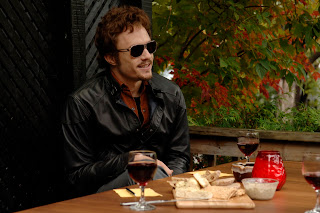 overlaid with music. Ledger, who died between the theatrical release of the film and the DVD, does great work in the film and obviously bonded with Haynes, who gets choked up more than once on the commentary during Ledger’s scenes.
The real meat of the extras is ‘A Conversation with Todd Haynes,’ which runs about 40 minutes or so. It’s a combination of an interview done specifically for the DVD and clips of the writer-director talking about the film at various film festivals and junkets, and considering the piecemeal nature of it, it’s really interesting stuff. Haynes is articulate, smart and funny, and speaks passionately about all aspects of a film that was clearly a labour of love. Haynes also provides commentary for the film, one of the most engaging tracks I’ve heard in a while, and it actually made me like the film a lot more in retrospect than I did when I first saw it, which is something not a lot of commentary tracks manage to do.
Rounding out the extras is ‘The Red Carpet Premiere,’ a collection of interview snippets from, well, the red carpet premiere. There’s not much of value here that isn’t covered elsewhere on the DVD, but in it Ledger sums up I’m Not There better in one sentence than I could in this long, rambling review, so I’ll leave it to him: “You leave the movie with no more knowledge of Dylan than when you entered the film.” It’s absolutely true, and in the best way possible.
Director Todd Haynes’ Bob Dylan film is easily one of the most unique takes on the biopic in recent memory. As you probably know, the “gimmick” is that Haynes, in telling the stories – sometimes real, sometimes exaggerated and sometimes entirely fictional – of Bob Dylan’s life, cast six different actors all to play versions of the music legend. Marcus Carl Franklin plays Woody, a young black kid passing through ‘50s America claiming to be Woody Guthrie and acting like he’s still in the Depression; Ben Whishaw is Arthur (as in Rimbaud), a poet being interrogated in some indeterminate historical period; Christian Bale is Jack Rollins, an early-‘60s folk singer known for his protest songs who
 later abandons his musical career at the peak of his fame to become a preacher; Heath Ledger is Robbie Clark, an actor (who, in a clever bit of stories intermingling, broke through as a star playing the Christian Bale character in a biopic) whose marriage falls apart as we watch; Cate Blanchett portrays Jude Quinn, the most obvious visual reflection of Dylan, as seen in mid-1960s London; and Richard Gere as Billy (as in the Kid), a former outlaw living in exile in turn of the century America.
Before I go any further, I should probably mention that I’m not a particular fan of Bob Dylan. I respect him immensely for all he’s accomplished, and I’ve never heard a song by him that I haven’t liked. It’s just that fully getting into Dylan always seemed so intimidating due to the sheer volume of material. But for now I’ll just smile to myself when ‘The Man In Me’ (from The Big Lebowski) comes on my iPod and leave it at that. The reason I mention all of this is that your interest in I’m Not There, like mine, will likely live or die by your interest in and knowledge of Bob Dylan. Which is simultaneously the best and worst thing about the movie.
The reason I put gimmick in quotes earlier is, as much as the central conceit of I’m Not There seems like a stunt, it’s not. Dylan has always been famous partly for his refusal to be pinned down to one particular persona, so casting different actors to portray these different aspects of Dylan is actually quite brilliant, and the performances are great across the board (though I thought Blanchett, Whishaw and Bale in particular really tore it up).
When I said your interest in Dylan will determine your interest in the film, the best example I can think of are the sections where Dylan, in his various guises, interacts with women. Now, I know a bit about Dylan’s biography, most of the big touchstones (beginnings riffing on/ripping off Woody Guthrie, protest songs, going electric, “Judas!” at the Royal Albert Hall concert, etc.), but really, just the Rock History 101 basics. But all the parts of the movie that involve Dylan and his relationships, which is the thrust of the Heath Ledger segments, left me cold, mostly because I could detect that his wife (played by Charlotte Gainsbourg, so gorgeous that Haynes remarks on the extras that meeting her was the first time he’d ever wished he was straight) was somebody I was supposed to know, but I didn’t. As a result I could never shake the feeling in those scenes that I was missing something crucial. Instead, all I got was the sad story of the end of an actor’s marriage to his pretty French wife, paralleled by the end of the Vietnam War. I’m sure this references one of Dylan’s actual more well-known marriages, but the significance was lost on me and Haynes has no interest in filling me in.
The other side of this particular coin, however, is that Dylan fans will absolutely love this movie. It’s dripping with sly (and overt) references to his work, to works about him, and to the general myth of “Bob Dylan.” If you know what the Newport Folk Festival is, I'm Not There is probably going to flip your shit.
I’m Not There is obviously a very ambitious film, and for the most part it’s successful, especially when considering it was shot on a tiny budget in Montreal (which stands in for Depression-era America, 1960s London, the Wild West, Greenwich Village and more). And while Haynes does miss a few times – the references to Fellini’s 8½ in the Jude segment are either clever or pretentious, depending on your take – I’ve always said I’ll take an ambitious failure
over a safe, aggressively mediocre “success” any day. And while I wouldn’t call I’m Not There a failure, it’s far from perfect, but compared to the Hollywood gloss of Walk The Line (which was so afraid of actually diving into the subject of Johnny Cash, probably the only figure to exceed Dylan in terms of both his cultural stature and complexity, that it just gave us a trite story of a guy who did some drugs and was redeemed by the love of his pretty wife), Haynes’ meditation on art and identity stands head and shoulders above it. It’s a movie for actual Bob Dylan fans, and to a lesser extent cinema buffs, but it has no real interest in trying to appeal to a broader, “mainstream” audience by dumbing anything down. Where Walk The Line can’t even be bothered to skirt the edges of the complicated role religion played in Johnny Cash’s life, I’m Not There dives headfirst into Dylan’s Christian period, via the Bale character.Ever since first hearing about the project, I’m Not There sounded like the recipe for a colossal, indulgent mess of a movie. The good news is, it’s not a colossal mess, but the bad news is it is pretty indulgent, and not just because Haynes got to make a movie about one of his heroes; I'm Not There is largely about artists and their relationship to their art, and it's difficult not to read it as about Haynes more than Dylan.
Overall, as a guy who loves the medium of film, I’m Not There is a pretty amazing piece of work. Haynes bites off a lot – sometimes more than he can properly chew – but his love for Dylan just leaps from the screen and carried me through the more fanboyish aspects of the film that sailed over my head. But if you’re a Dylan fan, Haynes’ trippy journey through the lives of Bob Dylan is one you can’t afford to miss.
GRADE: B
THE EXTRAS
The first thing I noticed with the I’m Not There DVD was that, for a film about Bob Dylan, aside from a “Dylanography” (listing his entire recording catalogue as well as the many, many books about his life and his music, which is impressive in and of itself), there’s really almost nothing about Dylan himself in any of the extras on this two-disc set. But once I started to go through the bonus material, I found myself actually more interested in the making of the film than I was in Dylan as a musical/historical figure. And to be fair, there are two fairly well-known documentaries about Dylan already out there in D.A. Pennebaker’s 1967 film Don’t Look Back and Martin Scorcese’s 2005 doc No Direction Home: Bob Dylan. And Haynes says in one of the features that he’s still never actually met Dylan, so it does seem sort of appropriate. The film, after all, is about considerably more than just Bob Dylan, and the production (low budget and under insane amounts of time pressure, apparently) seemed quite interesting, if not necessarily a fun experience for those involved, so there’s lots of interesting material here.
Extras on disc 1 include text pieces introducing the film, often reviews of the film from its theatrical run, which seems a like nod to I’m Not There’s sometimes weird, consciously impenetrable nature. Maybe they felt they needed a preamble for such an "artsy" movie in order for “regular folks” to understand it? I don’t know, but they’re pretty well-written and interesting, and work as cool companion pieces to the film. (Many of the bonus features on the I’m Not There DVD are text pieces, which is a cool – though presumably unintentional – throwback to old DVDs, and a feature that's probably been cast off needlessly in favour of "sexier" multimedia features like games or just more EPK fluff. There’s lots of fascinating magazine and newspaper articles about the film and Dylan in general here, so again, Dylan heads take note.
Other extras include two theatrical trailers, as well as a bunch of cool, unused trailers based around Dylan’s proto-music video for ‘Subterranean Homesick Blues,’ (you know, the one where he’s bored-looking in an alley holding cards with lines from the song), including two versions with the entire cast recreating the clip, as well as takes of each of the cast members doing it individually. (For the record, the best at keeping pace with the song was Richard Gere; the worst was probably Marcus Carl Franklin, though Heath Ledger gets bonus points for taking drags from a cigarette before each verse.) For a collection of trailers, it’s surprisingly fun.
There’s also a 20-minute feature on the making of the soundtrack, which will mostly just interest to music geeks, as well as more traditional extras like audition footage, a couple of deleted scenes and some extended takes of the musical performances in the film (which I’d be remiss if I didn’t mention are all fucking amazing).
There’s also a nice ‘Tribute to Heath Ledger,’ a brief montage of footage from the film itself and outtakes,
 overlaid with music. Ledger, who died between the theatrical release of the film and the DVD, does great work in the film and obviously bonded with Haynes, who gets choked up more than once on the commentary during Ledger’s scenes.
The real meat of the extras is ‘A Conversation with Todd Haynes,’ which runs about 40 minutes or so. It’s a combination of an interview done specifically for the DVD and clips of the writer-director talking about the film at various film festivals and junkets, and considering the piecemeal nature of it, it’s really interesting stuff. Haynes is articulate, smart and funny, and speaks passionately about all aspects of a film that was clearly a labour of love. Haynes also provides commentary for the film, one of the most engaging tracks I’ve heard in a while, and it actually made me like the film a lot more in retrospect than I did when I first saw it, which is something not a lot of commentary tracks manage to do.
Rounding out the extras is ‘The Red Carpet Premiere,’ a collection of interview snippets from, well, the red carpet premiere. There’s not much of value here that isn’t covered elsewhere on the DVD, but in it Ledger sums up I’m Not There better in one sentence than I could in this long, rambling review, so I’ll leave it to him: “You leave the movie with no more knowledge of Dylan than when you entered the film.” It’s absolutely true, and in the best way possible.
Labels: Big Lebowski, biopic, DVD review
¶ 12:55 PM 0 Comments


