Ain’t It Cool News posted some images of what is apparently the almost-final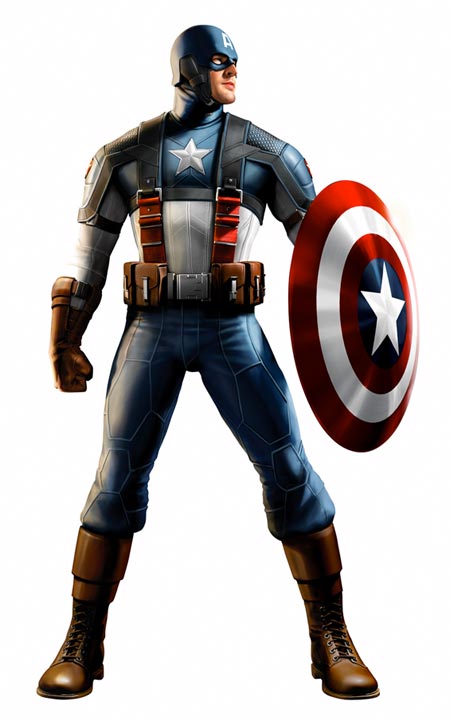 costume designs for Marvel’s upcoming Captain America movie. I’m okay with them. I’m not the world’s biggest Cap fan (though the current run, written by the brilliant Ed Brubaker, is some of the best mainstream superhero comics going), so I can’t pretend I have some deep, nostalgic connection to the little wings on his head on his outfit in the comics (but the comic geek in me sort of misses them), but my first thought was this seems like a pretty cutting-edge costume considering the fact that, as I understand it, the bulk of the movie’s action is set during the Second World War. And as a friend of mine pointed out, that there’s really a lot of pouches on there.
All that being said, these are obviously just illustrations, so I’ll reserve my judgment until I see the first actual photos of Chris Evans in the real-life suit. As much as the buzz surrounding Captain America was somewhat negative until Evans’ casting (script problems, budget disputes between the director and Marvel, etc.), I’m cautiously optimistic that the movie will be good. I like Evans a lot, and I really like the stage-setting for Thor and The Avengers Marvel started doing in Iron Man 2. Who am I kidding? Screw head-wings, I’m excited. Captain America: The First Avenger hits theaters next summer.
* * *
Because I am a kind and benevolent movie blogger, I will leave you today with the new trailer for Edgar Wright’s Scott Pilgrim vs. The World. I’ve already gushed over how awesome the comic is, and how primed I am for this movie, so I’ll skip that. But I will say that this new trailer (which really showcases the action; I really can’t wait for this thing) also puts to rest a lot of the concerns I had about Michael Cera playing the title role. I’ve said before that the character of Scott Pilgrim and the persona Cera adopts in everything he’s ever done couldn’t be more different, but it looks like he’s finally moving out of his stuttering-wallflower wheelhouse.
I want to see this movie so badly I’m on the verge of tears. Scott Pilgrim vs. The World is out August 13.
Labels: comics, Movie news, self-indulgence, superheroes, trailers
¶ 10:13 AM 2 Comments
So news came down the pipe this week that the latest big video game franchise to get the Hollywood adaptation treatment is Mass Effect, a plot-heavy sci-fi action/RPG where the player controls the captain of a starship with the token motley crew of eccentrics and aliens. Coupled with the insane amount of hype that Prince of Persia has been getting (the ads have been inescapable for weeks now), something in my brain just snapped, and I’ve had enough. Enough with the video game movies, Hollywood. They’ve never worked (either financially or  artistically), and I really don’t think they ever will, whether it’s Prince of Persia or Mass Effect or Gears of War or any other big-name game franchise that’s been optioned for a movie. And I’m saying that as a both a movie buff and a gamer.
I love Mass Effect, a lot. So much so that my Xbox 360 recently died on me and I’m already resigned to dropping about $300 just so I can re-play the Mass Effect games as well as the upcoming Mass Effect 3. I’m a fan. Not a posting-fanfiction-on-message-boards fan, I grant you, but I probably have more invested in Mass Effect than the vast majority of “average” moviegoers. And I think the idea for a Mass Effect movie is awful.
Here’s the crazy part of why I’m so sick of movie games: I like video games. A lot. Probably more than you. No, screw it, I can almost guarantee I like games more than you. But the movies suck. They always suck. They almost certainly never won’t suck. I want them to be good. But they never are. You know what one of the best video game movies made yet is? Mortal Kombat. And that movie is not good at all (and I know from martial arts movies). Trust me. Mortal Kombat is not a good movie. But compared to literally every other video game movie – Hitman, Max Payne, Super Mario Brothers, Resident Evil, whatever – it’s pretty awesome. It’s entertaining and it’s faithful to the story of the games (a term I use quite loosely indeed), and those are two things that are almost never said about movies based on games.
Why is that? I have some theories. And they’re not the sort that are popular in hardcore gaming circles. I think the reason movies based on games are always crap is that the stories the movies are adapting are always crap. Games pretty much all tell stories nowadays (obviously I don’t mean Wii Sports here), and they always reference movies, because cinematic storytelling is what games have aspired to for as long as cutscenes have existed. Mass Effect, to continue with this example, has as detailed a sci-fi universe behind it as any game I’ve ever played, but it’s filled with ideas and concepts that are borrowed from existing sci-fi movies, TV shows and books. There’s nothing terribly original in there beyond a few clever superficial things, and so a Mass Effect film will automatically feel very derivative to an “average” (i.e. non-gamer) audience. They’d only see the Star Trek-inspired ships and the Star Wars-inspired aliens and concepts. What makes the Mass Effect games so special isn’t the plot itself, it’s how the player interacts with it. Mass Effect is a brilliant game because it fuses all these things – Star Wars, Star Trek, Battlestar Galactica, Blade Runner – and lets you control the story. And that detail, that control, is the thing that, by definition, all game movies will lack. It’s also the thing that Hollywood still doesn’t seem to understand: watching a character do something amazing onscreen will never replicate the excitement of feeling like you’re doing something amazing. It’s the sort of detail that most studio executives and producers (I’m gonna go ahead and assume that most Hollywood shot-callers aren’t avid gamers) miss because they lack sufficient hands-on experience with games.
Len Wiseman, who was at one time attached to direct the planned Gears of War movie (another really fun game that would most likely make a derivative, mediocre-at-best movie), became familiar with the game when he picked footage out of a lineup of big games for a monitor to be glimpsed in the background of a scene in Live Free or Die Hard. Before that, he’d never heard of the game, which was basically an instant phenomenon in the gaming world when the first title was released in 2006. Now, I’m not slamming Wiseman for his lack of gamer cred (if I made big-budget blockbusters and was married to Kate Beckisndale I doubt I’d have as much time for Red Dead Redemption as I do currently), I’m just saying that that story sort of explains how unfamiliar Hollywood still seems to be when it comes to games. So of course they don’t know how to adapt one properly. Studio execs really only respect one thing, and that’s numbers. Naturally they get all hot and bothered when someone shows them how much money a huge game release like Halo or Call of Duty: Modern Warfare can rake in in a day or a week (a major game release like Halo regularly rake in billions of dollars, something Hollywood movies only do once in a blue moon; Grand Theft Auto IV made more money in its first week in stores than The Dark Knight did in its entire North American theatrical run); they just think about how much money they’ll make a movie based on that property would bring in for them hits it big – if just a fraction of the tens of millions of people who play Halo or World of Warcraft online shell out $10 or $12 for a movie ticket, they’re rolling in it – except that never happens. But still, we have movies based on hit games like World of Warcraft, Bioshock, Gears of War and Halo currently in various stages of development hell, and if any of them are made (which still looks like a big “if” at this point, though nothing that a fat opening weekend for Prince of Persia can’t fix), they will almost certainly be bad movies.
But the main difference between adapting games to movies and adapting other media is that other adaptations, be they of books, comics or TV shows, aren’t adapting interactive media. There’s a narrative structure already in place from which to draw, and the problem with the narrative structures of most games is that they exist first and foremost to help create a compelling game, which is vastly different from a compelling movie, and the gulf between those two is far more vast than the gulf between a compelling book and a compelling movie (though that gap can also be very significant). It’s also why the stories in most games, objectively speaking, are bad, at least compared to movies. Call of Duty: Modern Warfare 2 is one of the best-selling and best-reviewed games ever released, and I’ve played through it twice and I still couldn’t tell you what exactly the story is, but it seemed liked the stuff of a second-rate 24 ripoff. But that doesn’t mean the game isn’t awesome, it’s just different from a movie. A Call of Duty movie would just be a bunch of soldiers running around shooting terrorists. It would be terrible. But the game’s a blast to play. Because you’re playing it, not just watching what happens and listening to the dialogue.
Some game people get it. Rockstar Games has been notoriously reluctant to sign over the movie rights to their blockbuster Grand Theft Auto franchise, because Rockstar is staffed by very smart, savvy folks who seem to understand how a GTA movie would, by definition, suck, primarily because you’re not playing it. Removing interactivity from these characters and stories and expecting them to still connect with audiences is like adapting Avatar into a radio broadcast and then scratching your head when the same audiences don’t turn out to listen to the adventures of Jake Sully and the Na’vi on Pandora. Not only is it not the same experience, it effectively removes the most compelling part of the source material (in Avatar’s case, the visuals; in a game’s case, the part where you play it and it’s fun) and presents the hollowed-out husk to audiences. No wonder nobody’s interested.
Labels: rants, self-indulgence
¶ 9:40 AM 0 Comments
Bottle Rocket
My favorite movie by Wes Anderson (one of my favorite directors) is also his first
 . I saw Bottle Rocket in theatres in 1996 (I was in high school and talked a couple of friends into seeing it with me based on a small TV item on it I’d seen that made me laugh), and I laughed as hard as I ever had at a movie. Anderson’s later films would solidify his reputation for quirky movies with quirky characters, and while the same can definitely be said for Bottle Rocket, it’s not as stylistically out-there as his better-known movies like Rushmore and The Royal Tenenbaums. It’s also more obviously a comedy – it’s basically a riff on the post-Tarantino crime movies that were then flooding the movie landscape, following a trio of privileged kids-turned-wannabe criminals more interested in the lifestyle than with committing actual crimes – than his later movies, though Bottle Rocket has tons of heart, especially in the relationship between old friends Anthony (Luke Wilson) and Dignan (Owen Wilson). This is a movie I watch when I’m feeling down, and it never fails to pick me up, and the final shot of Dignan waving to Anthony and Bob (Robert Musgrave) makes me smile just thinking about it.
 Since this movie’s release, both of the Wilson brothers have become big movie stars, but I’ll always reserve a place in my heart for them, no matter how many crappy movies they make, because of Bottle Rocket.
Seven Samurai
There isn’t a whole lot in movies I like more than samurai. I’ve always found them fascinating, and I’ve read more th
 an a few books on Japanese history, and that fascination can be traced back to the films of Akira Kurosawa. I actually saw Yojimbo first, and it knocked me on my ass, but when I got around to seeing his 1954 masterpiece, it was a revelation. I’d always enjoyed action movies about an ragtag group of guys who have to defend something (a building, a town, a planet) against a much larger force, and Seven Samurai is the template, in one form or another, for all of those movies (most obviously The Magnificent Seven, itself a really cool movie). About midway through my first viewing of this movie, I understood why it’s considered one of the greatest films ever made. The performances are incredible – especially the legendary Toshiro Mifune, whose character is almost the exact opposite of his iconic turn in Yojimbo – the characters are great, the story is totally gripping (the last hour-plus of the movie, basically, is an extended siege sequence)…there’s almost no aspect of this film that susbsequent action/adventure movies didn’t draw from. I’m an action movie guy, and to watch Seven Samurai is to witness the creation of the action movie as we know it.
Yojimbo
This is the Akira Kurosawa movie I actually came to first – I’m embarrassed to a
 dmit, after watching Walter Hill’s so-so prohibition-era 1996 remake with Bruce Willis, Last Man Standing – and it remains one of the formative movie-watching experiences of my life. I’d rented it after seeing Last Man Standing (which I’d quite enjoyed, but seeing the real deal has since ruined it for me), and I watched it, rewound the tape, and immediately pressed “Play” again. I’ve never been much of a fan of westerns (though I can appreciate a good one when I see one), but this was a western with, to me, an even cooler lead than Clint Eastwood’s Man With No Name in Toshiro Mifune’s chin-scratching swordsman, and the story, in which he plays two warring groups of bandits off one another as a hired bodyguard, managed to be gripping and absurdly hilarious at the same time. (Kurosawa and Mifune emphasized the comedy even more in the 1962 sequel, Sanjuro). Yojimbo is one of those movies that I’d been waiting my whole life to see, I just didn’t know it at the time.
Point Break
I’ve m
 entioned more than once how much I love director Kathryn Bigelow, and this is my favorite of her movies. I realize Point Break has become something of a camp classic, but my appreciation of this movie, about an FBI agent who goes undercover to crack a ring of surfing bank robbers, has nothing to do with camp or irony. I do think it’s hilarious – Gary Busey and John C. McGinley provide two of the funniest supporting performances in any action movie I’ve seen – and some of the plot twists are hokey (it’s an action movie from 1991 after all), but the surfing and skydiving sequences are gorgeously shot, Patrick Swayze is a fantastically charismatic villain, and it’s got one of the best car chases I’ve ever seen. I’ve seen Point Break so many times I know the script almost by heart, and it never gets old to me.
The Last Boy Scout
Yes, another early-‘90s actioner; I will never deny that I embrace my roots. Tony Scott’s The Last Boy Scout is one of the first movies I watched incessantly, and I still do to this day. The primary reason for this is the sublime script by Shane Black, who’s riffing on classic detective stories (Black, who penned the original Lethal Weapon before eventually almost destroying his career
 with the screenplay for The Last Action Hero, would later go even further down this route into full-on homage in his directorial debut/comeback, 2005’s brilliant Kiss Kiss, Bang Bang – read more about it here). Black’s scripts share a lot of common threads – a pair of bickering guys reluctantly thrown together to solve a case that they eventually realize is a much larger conspiracy, oddly articulate henchmen, a truckload of wonderfully quotable lines – but this one’s my favorite.
The story follows a burned out private eye (Bruce Willis) who teams with a washed-up former quarterback (Damon Wayans, with a stripper girlfriend played by a then-unknown Halle Berry) to unravel a conspiracy surrounding legalized gambling and pro football. That’s all beside the point though, as the exchanges between Willis and Wayans are what make this movie, and the way Black plays with the conventions of action movies, without going overboard with meta-humor like The Last Action Hero did. (“You’re the bad guy, right?” Willis asks Taylor Negron’s deliciously evil Mr. Milo shortly after they first meet. “I am the bad guy,” Milo responds enthusiastically.) More than any other movie on this list, The Last Boy Scout is far and away the movie I quote the most; there isn’t another movie I can think of that I’ve seen that has so many amazing and hilarious exchanges, my favorite being the brief scene in which Willis and Wayans discuss the latter’s leather pants. I’ve watched it probably 100 times, and it’s never not made me laugh like an idiot. Of all the movies I’ve listed here, The Last Boy Scout is probably the one that’s the least defensible from an objective standpoint, but it’s also the one that I probably get the most pure enjoyment out of watching. I don’t watch The Last Boy Scout to appreciate the craftsmanship or the technical achievement on display, I watch it because it’s 105 minutes of violent, foul-mouthed fun.
Labels: Lists, self-indulgence, Shane Black
¶ 9:03 AM 0 Comments
Keep in mind, this is a list of my favorite movies. That’s not the same as “the best” movies; I’m not trying to argue that Kill Bill is a better film than The Godfather or Citizen Kane, just that I have a special place in my heart for that movie that I don’t have for those classic films. (Both of which are brilliant and deserve their places in history, for the record.) These are just the movies that remind me why I love movies in the first place. I can watch them over and over again, any time, sometimes finding new stuff to love each time, sometimes just curling up with them like an old sweater.
Some of you will also probably notice that these are relatively recent movies. It’s not that I don’t appreciate older classics, but I didn’t grow up watching them and therefore they’re not as crucial to my development as a movie geek. So yeah, most of these films were released within my lifetime. Regardless of their genre or their place in the annals of cinema history, these are the movies that always do it for me no matter how many times I watch them (and most of them I’ve been watching regularly for years, even decades).
Blade Runner
If I had to pick one film here as No. 1, it would be this one. I realized a few years ag
 o that Ridley Scott’s 1982 sci-fi classic has been creeping up my ever-shifting mental top 10/20/50/100 list consistently for some time. I didn’t really like Blade Runner very much at all the first time I watched it; I was too young to appreciate it and I was disappointed there wasn’t more “action.” But I got into it a few years later and have been watching it regularly ever since. I realized it was probably my favorite movie, period, when I noticed that, unlike all the other movies mentioned here (and in history), I fall in love with Blade Runner more each time I watch it. There isn’t anything about this movie that I don’t love, from the story to the production and set design to the music to the acting and the characters (Rutger Hauer’s Roy Batty is easily one of my favorite movie villains of all time) to its central theme of what makes us human to just the overall feel, Blade Runner is, for me, just about as good as movies get.
Kill Bill
For a while after this movie came out, it was the one I mentioned when asked for my favorite, but I always sort of cringed when I answered, as I felt like there were some important caveats that w
 ere difficult to explain. (I always think it’s sort of lame when people cite such a recent movie their favorite; films have to marinate in the psyche, I think, before they can honestly be called a person’s favorite.) But seeing Volume 1 for the first time in the theater remains one of the most mind-blowing movie experiences I’ve had. My love for Kill Bill (specifically Volume 1; it’s the one with all the martial arts, after all) is intensely personal; I wouldn’t even argue this is Quentin Tarantino’s best movie, but I grew up a geek for much of the same stuff he did, so his mash-up of samurai movies and kung fu movies and spy movies and westerns, as well as a lot of weird European movies I’ve never seen (with Sonny F***ing Chiba and an anime sequence tossed in for good measure) felt like someone made a movie just for me. I love martial arts movies, and the House of Blue Leaves fight scene in Volume 1 remains the most incredible on-screen fight I’ve seen. Things slow down a little for me in Volume 2, as there’s less fighting and more talking (though I love David Carradine’s performance, and it’s all in the second one), but Tarantino’s take on hardcore action flicks still turns my crank like few other movies ever have.
True Romance
I’ve never really considered myself that much of a Quentin Tarantino fan, but h
 e’s connected to two movies on this list, so I guess I should reconsider that stance. He only wrote True Romance (it was directed by Tony Scott, who has another movie on this list), but I’ve been a freak for this movie since I first saw it as a teenager. I’ve seen this thing dozens of times, but I still get goosebumps during the scene near the beginning where Patricia Arquette’s Alabama confesses to Christian Slater’s Clarence that (1) she’s actually a call girl hired by his boss to show him a good time on his birthday and (2) she’s in love with him. Throw in flat-out brilliant supporting performances from Christopher Walken, Dennis Hopper, a pre-Sopranos James Gandolfini and Gary Oldman (reigning King of Movie Villains), and what is still my favorite Brad Pitt performance ever, and I almost stopped writing this to watch it again.
Boogie Nights
I guess this is the only movie on this list that isn’t really a genre movie in the traditional sense, but Paul T
 homas Anderson’s epic about the golden age of the porn industry is one of the few three-hour-long movies that I can watch over and over and over again. This movie manages to be sad, hilarious, uplifting and terrifying at various points (occasionally all at once), and no matter how many times I watch it, I’m still amazed how well Anderson (and his fantastic cast) pulls it all off. Boogie Nights came out during a crucial stage in my development as a film lover; within about a year or two, this, Three Kings, Fight Club and Rushmore all came out, all of them blowing my mind, and it felt like a mini-renaissance was taking place in American film (and the directors behind all of those movies are still filmmakers whose careers I follow closely up to this day), but Boogie Nights was so audacious and unlike anything I’d seen up until then (I’ve subsequently seen a lot of the movies Anderson was drawing from, but it doesn’t change how much I love this film) that it's permanently etched into my mind. Anderson has yet to make a movie I haven't liked (I even dig Magnolia), but this is still the movie I think of when I think of him and his work.
Out of Sight/The Limey
At my old job, working at a music magazine, my editor would ask us all every holiday season to compile a list of our favorite albums and singles of the year, and every year I’d tr
 y to cheat by putting the last one on my list as a tie. I never managed to slip this past him – he always made me discard one – but this is my list, and nobody edits this blog but me, so eat it Steve, this one really is a tie.
Actually, the real reason I included these two films together – made by my favorite director, Steven Soderbergh, within a year of one another – is that they’re so similar in many ways that I can’t help but associate them. Out of Sight was the movie the movie where I fell in love with Soderbergh’s movies. I love how it veers from being as funny as any comedy one moment to being tense and scary (like any good crime movie) at its climax. (I gather this is actually common to many Elmore Leonard’s novels, and it seems to be a balance that few filmmakers who’ve tried to adapt his stuff can pull off.) It’s also the first movie in which George Clooney truly was a movie star (and the last time I took Jennifer Lopez seriously as an actress), and it’s filled with crackerjack supporting actors like Don Cheadle, Ving Rhames and Steve Zahn. And the bit between Clooney and Cheadle in the prison library may hold the record (in my head at least) for the most great lines in a single scene.
The Limey sees Soderbergh taking many of the vaguely arty editing tricks he played in the m
 ore commercial, studio-produced Out of Sight (like cutting to shots of characters just staring at each other while dialogue plays out, as if they’re communicating with their minds) even further with this low-budget riff on revenge movies. Terence Stamp is simply amazing as Wilson, a British ex-con trying to get to the bottom of his daughter’s mysterious death in L.A., and Peter Fonda is equally brilliant as a slimy record producer who played a role in her demise. (Fonda also manages to be a great movie villain without ever really doing anything particularly villainous on screen; he just feels evil.) The Limey manages to be artful and sort of experimental while still working as a satisfying genre movie; the scene where Stamp walks back into a building after being roughed up by thugs to kill a whole bunch of people (none of which we actually see) remains one of the most supremely badass sequences I've ever seen in a movie.
Tomorrow: The final five movies in my Top 10 (which the more astute among you have realized is actually a Top 11), including a few movies made before I was born...!
Labels: Lists, self-indulgence
¶ 10:36 AM 0 Comments


