People Tell Me I Look Like Han Solo.
Friday, April 16, 2010
DVD Review: Defendor
THE MOVIE
Defendor is a small Canadian film (though that’s sort of redundant; a “big” Canadian film is sort of an oxymoron) about Arthur Poppington, a dull-witted but good-natur ed guy who thinks he’s a superhero. Similar to the bigger-budget Kick-Ass (which coincidentally opens today; look for a review on Monday), Defendor explores the question, “What would happen if someone actually put on a costume to fight crime?” When I first saw the trailer for Defendor ahead of last year’s Toronto International Film Festival, I noted that it looked interesting and ambitious (which is code for “I have no idea if they’ll pull this off”), and as a lifelong fan of the superhero genre, I can say that while Defendor certainly isn’t perfect, it does manage to ride its unique tone quite well up until the very end, and first-time writer/director Peter Stebbings himself has immediately established himself as an up-and-coming filmmaker to watch.
Woody Harrelson plays Arthur, a semi-homeless city worker who lives in an old warehouse that he’s turned into a sort of lower-than-low-rent Batcave, where he hones his skills with a slingshot, marbles, lime juice, his grandfather’s World War II trench club, and wasps he keeps in a jar to throw at his enemies. He prowls the streets of Hammertown (it’s never clear if this is the actual name of the city or a nickname) as Defendor – he gets really gets upset when people pronounce it “Defender” – in his homemade superhero costume in search of Captain Industry, a mysterious (and most likely fictional) villain he blames for his mother’s death. He meets a young crack-addicted hooker named Kat (Kat Dennings, from Nick and Nora’s Infinite Playlist) who lies and tells him she has a line on where he can find Captain Industry, and the two strike up a surprisingly sweet relationship as she tries to help Defendor in his fight against crime.
The trickiest part of Defendor is the tone; while the idea of a naïve dimwit (Arthur is said to have an IQ of 80) who thinks he’s a superhero seems like the stuff of wacky comedies (and usually it is), Defendor is much darker and more realistic. There’s certainly a lot of funny stuff here, but Stebbings is more interested in examining what kind of person would actually do that, what would happen to him, and what kind of effect that would have on the people around him. The combination of vaguely goofy comedy and gritty realism is a heck of a tightrope to walk, and for the most part Stebbings succeeds. I was pretty stunned at how w ell everything holds together for the majority of the film, and while the ending sort of collapses (more on that later), I was on the whole quite impressed.
Defendor is a remarkably good-looking movie given its budget; Stebbings has a great visual eye, and the action sequences are quite well put together. He manages to evoke the superhero genre while also clearly grounding the film in the real world; more than any movie I’ve seen, Defendor shows what would probably actually happen if someone put on a costume to wage a one-man war on crime. It’s never glamorous or sexy, and it never goes the way Arthur planned. Stebbings clearly has an understanding of comics and superheroes, and while he approaches the concept from a decidedly grown-up perspective, it never feels like he’s condescending Arthur/Defendor, or superheroes in general.
None of this would work at all if it wasn’t for an actor as solid as Woody Harrelson in the lead. He manages to make Arthur sympathetic and funny, but I found myself also cheering for Defendor, as silly as he is. It would be pretty easy to make Arthur just a buffoon, but Harrelson gets to show the pain at the character’s core that eventual ly drove him to become Defendor. Defendor would have been an absolute mess without an actor as good as Harrelson in the lead.
But it’s Elias Koteas that’s Defendor’s secret weapon. Koteas is a Canadian character actor who’s been in a ton of movies over the years (he first caught my eye in 1990’s live-action Teenage Mutant Ninja Turtles: The Movie, playing Casey Jones, a low-rent vigilante who’s weirdly similar to Defendor), and he’s great in every single one. Here he chews the scenery wonderfully as the villain, a crack-smoking corrupt cop who hangs out with prostitutes and Serbian crime bosses, and like most great movie villains, manages to be hilarious and scary as hell at the same time. It’s an incredible performance, and the film takes on a wild energy every time Koteas is on the screen.
Michael Kelly is another excellent character actor I’ve been seeing for years who really gets a lot to bite into here. I first noticed him as the jerky security guard in Zack Snyder’s Dawn of the Dead remake (he also completely steals the hilarious/awful Law Abiding Citizen in ONE SCENE), and he’s wonderful and warm as Arthur’s boss and friend. He plays the normal guy who grounds Arthur and his pretty out-there behavior in reality, and he’s brilliant.
As I mentioned, it’s the ending of Defendor where things fall apart. I obviously won’t spoil the details, but its seriousness felt unearned. I understand what Stebbings was going for, and it’s not that he lacks the talent to pull it off, but rather it felt like he’d spent the entire movie slowly (albeit entertainingly) painting himself into a corner, and wasn’t able to work the miracle required to get himself out of it. As much as it definitely took away from the movie, I can’t say it ruined the entire experience, and I’ve always maintained that I’ll take an ambitious failure over a movie that plays it safe and doesn’t take chances. Defendor definitely falls into the former category (though I wouldn’t use the word “failure”; more like an interesting disappointment) and as much as I had my issues with it, it’s the work of a very talented filmmaker assisted by an excellent cast.
GRADE: B
THE EXTRAS
The Defendor DVD has a really nice collection of extras on it, including commentary from Stebbings, Harrelson, Dennin gs and producer Nick Tabarrok. The track has a nice, conversational vibe; everyone’s friendly and cool and funny. It’s bit of a mutual admiration society, but everyone’s charming enough that it doesn’t grate.
There’s also a collection of five featurettes that, if watched back-to-back, works as a nice little making-of mini-documentary that covers almost every aspect of production, from the project’s genesis to the casting to Stebbings himself. I found it all pretty interesting, and considerably better than the standard fluff you that passes for bonus material on most DVDs. There’s also a handful of deleted scenes and a funny little outtake reel. Overall this is an excellent little DVD for a quirky take on superhero movies.

Defendor is a small Canadian film (though that’s sort of redundant; a “big” Canadian film is sort of an oxymoron) about Arthur Poppington, a dull-witted but good-natur
 ed guy who thinks he’s a superhero. Similar to the bigger-budget Kick-Ass (which coincidentally opens today; look for a review on Monday), Defendor explores the question, “What would happen if someone actually put on a costume to fight crime?” When I first saw the trailer for Defendor ahead of last year’s Toronto International Film Festival, I noted that it looked interesting and ambitious (which is code for “I have no idea if they’ll pull this off”), and as a lifelong fan of the superhero genre, I can say that while Defendor certainly isn’t perfect, it does manage to ride its unique tone quite well up until the very end, and first-time writer/director Peter Stebbings himself has immediately established himself as an up-and-coming filmmaker to watch.
 Woody Harrelson plays Arthur, a semi-homeless city worker who lives in an old warehouse that he’s turned into a sort of lower-than-low-rent Batcave, where he hones his skills with a slingshot, marbles, lime juice, his grandfather’s World War II trench club, and wasps he keeps in a jar to throw at his enemies. He prowls the streets of Hammertown (it’s never clear if this is the actual name of the city or a nickname) as Defendor – he gets really gets upset when people pronounce it “Defender” – in his homemade superhero costume in search of Captain Industry, a mysterious (and most likely fictional) villain he blames for his mother’s death. He meets a young crack-addicted hooker named Kat (Kat Dennings, from Nick and Nora’s Infinite Playlist) who lies and tells him she has a line on where he can find Captain Industry, and the two strike up a surprisingly sweet relationship as she tries to help Defendor in his fight against crime.
The trickiest part of Defendor is the tone; while the idea of a naïve dimwit (Arthur is said to have an IQ of 80) who thinks he’s a superhero seems like the stuff of wacky comedies (and usually it is), Defendor is much darker and more realistic. There’s certainly a lot of funny stuff here, but Stebbings is more interested in examining what kind of person would actually do that, what would happen to him, and what kind of effect that would have on the people around him. The combination of vaguely goofy comedy and gritty realism is a heck of a tightrope to walk, and for the most part Stebbings succeeds. I was pretty stunned at how w
 ell everything holds together for the majority of the film, and while the ending sort of collapses (more on that later), I was on the whole quite impressed.
Defendor is a remarkably good-looking movie given its budget; Stebbings has a great visual eye, and the action sequences are quite well put together. He manages to evoke the superhero genre while also clearly grounding the film in the real world; more than any movie I’ve seen, Defendor shows what would probably actually happen if someone put on a costume to wage a one-man war on crime. It’s never glamorous or sexy, and it never goes the way Arthur planned. Stebbings clearly has an understanding of comics and superheroes, and while he approaches the concept from a decidedly grown-up perspective, it never feels like he’s condescending Arthur/Defendor, or superheroes in general.
None of this would work at all if it wasn’t for an actor as solid as Woody Harrelson in the lead. He manages to make Arthur sympathetic and funny, but I found myself also cheering for Defendor, as silly as he is. It would be pretty easy to make Arthur just a buffoon, but Harrelson gets to show the pain at the character’s core that eventual
 ly drove him to become Defendor. Defendor would have been an absolute mess without an actor as good as Harrelson in the lead.
But it’s Elias Koteas that’s Defendor’s secret weapon. Koteas is a Canadian character actor who’s been in a ton of movies over the years (he first caught my eye in 1990’s live-action Teenage Mutant Ninja Turtles: The Movie, playing Casey Jones, a low-rent vigilante who’s weirdly similar to Defendor), and he’s great in every single one. Here he chews the scenery wonderfully as the villain, a crack-smoking corrupt cop who hangs out with prostitutes and Serbian crime bosses, and like most great movie villains, manages to be hilarious and scary as hell at the same time. It’s an incredible performance, and the film takes on a wild energy every time Koteas is on the screen.
Michael Kelly is another excellent character actor I’ve been seeing for years who really gets a lot to bite into here. I first noticed him as the jerky security guard in Zack Snyder’s Dawn of the Dead remake (he also completely steals the hilarious/awful Law Abiding Citizen in ONE SCENE), and he’s wonderful and warm as Arthur’s boss and friend. He plays the normal guy who grounds Arthur and his pretty out-there behavior in reality, and he’s brilliant.
As I mentioned, it’s the ending of Defendor where things fall apart. I obviously won’t spoil the details, but its seriousness felt unearned. I understand what Stebbings was going for, and it’s not that he lacks the talent to pull it off, but rather it felt like he’d spent the entire movie slowly (albeit entertainingly) painting himself into a corner, and wasn’t able to work the miracle required to get himself out of it. As much as it definitely took away from the movie, I can’t say it ruined the entire experience, and I’ve always maintained that I’ll take an ambitious failure over a movie that plays it safe and doesn’t take chances. Defendor definitely falls into the former category (though I wouldn’t use the word “failure”; more like an interesting disappointment) and as much as I had my issues with it, it’s the work of a very talented filmmaker assisted by an excellent cast.
GRADE: B
THE EXTRAS
The Defendor DVD has a really nice collection of extras on it, including commentary from Stebbings, Harrelson, Dennin
 gs and producer Nick Tabarrok. The track has a nice, conversational vibe; everyone’s friendly and cool and funny. It’s bit of a mutual admiration society, but everyone’s charming enough that it doesn’t grate.
 There’s also a collection of five featurettes that, if watched back-to-back, works as a nice little making-of mini-documentary that covers almost every aspect of production, from the project’s genesis to the casting to Stebbings himself. I found it all pretty interesting, and considerably better than the standard fluff you that passes for bonus material on most DVDs. There’s also a handful of deleted scenes and a funny little outtake reel. Overall this is an excellent little DVD for a quirky take on superhero movies.
Labels: Canadian cinema, DVD review, indie cinema, superheroes
¶ 10:00 AM 0 Comments
Thursday, January 14, 2010
DVD Review: Trailer Park Boys: Countdown to Liquor Day
THE MOVIE
Ah, the Trailer Park Boys. The beloved Canadian sitcom (which was doing the faux-documentary thing before The Office) ran fro m 2001 to 2008 (including two TV specials), spawning two feature films, Countdown to Liquor Day being the latter, as well as the official, final, no-really-we-mean-it-this-time end of the Trailer Park Boys. Countdown to Liquor Day picks up as the boys are getting out of jail, two years after being busted at the end of the hour-long 2008 special. Would-be criminal mastermind Julian (John Paul Tremblay) swears he’s going straight for real this time, while the comically stupid Ricky (Robb Wells) tells the parole board up front that he’s planning to go back do growing pot (“I could tell you guys whatever you want to hear, or I can be honest. I’m gonna grow dope, ‘cause that’s what I’m good at. I grow the best dope of anybody I’ve ever met.”), while the bespectacled Bubbles (Mike Smith) just wants to get back to his shed and his kitties. But once they get out, the Boys realize their nemesis, Trailer Park Supervisor Jim Lahey, has transformed their beloved Sunnyvale Trailer Park into a more upscale community. (He also hasn’t had a drink in two years, but the title of the movie gives you a hint as to how that works out.)
Countdown to Liquor Day is clearly meant to the wrap up the series and give the beloved characters a proper send-off. There’s almost a sadness to the movie, a sense that the viewer (as well as the cast and crew) are really saying goodbye to the characters. Trailer Park Boys has never shied away from showing how important the Boys’ family unit is to each of them, but this time it feels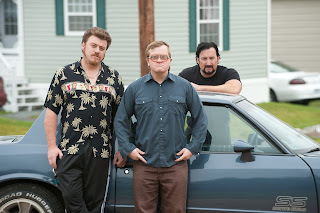 like every character is more willing to come out and say it (there’s a particularly touching scene where the usually too-cool Julian tells Bubbles that he loves him. It’s fairly clear through the run of the show that Julian would do anything for his friends, but to actually have him just say it to Bubbles the way he does is oddly affecting if you’re a fan). Or seeing how furious Ricky (easily the most misanthropic of the Boys, but also somehow the most loveable) gets when he learns that Mr. Lahey and his faithful sidekick/lover Randy (whose huge gut graces the DVD cover, and remains a hilarious visual gag on its own) were responsible for shaving a chunk out of Bubbles’ hair. As much as the scene where Ricky returns the favor to Randy is hilarious (it’s really one of the funniest sequences in the movie), it’s also very clear that Ricky is avenging his friend’s humiliation. There’s even a scene where Ricky breaks down and cries, which is about the last thing I ever expected to happen (it also leads to one of the best parts of the movie, Julian’s “Grade 12 is inside of you” speech).
There’s a tangible feeling throughout the film that this is it, the final Trailer Park Boys story. It’s sort of like Mike Clattenburg (who co-wrote and directed every single episode of the show, as well as all the movies, which is actually a pretty incredible achievement) and co.’s third kick at the can – the final episode of the proper show felt like the finale, as did the subsequent one-hour special, Say Goodnight to the Bad Guys (which is unfortunately still unavailable on DVD). The extended ending of the Trailer Park Boys franchise is a little like the end of the Lord of the Rings movies, but as with the 12-hour fantasy epic, I feel like TPB has earned the right to take its time wrapping everything up.
As much as I’m a fan of the show (read my review of the whole series here), I actually found I didn’t really laugh very much watching Countdown to Liquor Day. Which isn’t really a knock; the movie is very funny, but I found the comedy to be more tonal and character-based rather than laugh-out-loud hilarious (though the movie does have plenty of moments like that as well). I enjoyed Countdown to Liquor Day purely because I got to spend time with these characters again (including my personal fave, the painfully white would-be rapper J-Roc, who steals every scene he’s in and, next to Bubbles, is probably the smartest character on the show…which is sort of sad), and I’m happy to say the movie works very well as a capper to the Trailer Park Boys.
My favorite aspect of Countdown to Liquor Day is sort of subtle (but not really; it’s actually fairly important to the plot), and it marks a definite change in the Trailer Park Boys universe. As in all sitcoms, there’s a status quo to TPB to which things invariably return at the end of if not ev ery episode, every story arc: Ricky grows dope and is a screw-up, Bubbles lives in his shed with his precious kitties, Mr. Lahey’s a drunken mess, and Julian is an ostensible small-time criminal mastermind who always has a plan and is generally looked up to by everyone in Sunnyvale. But Countdown to Liquor Day begins by flipping one very important part of that premise: now, after years of ridiculous failures that have landed himself and his buddies in jail numerous times, just about everyone in Sunnyvale views Julian as a loser. It’s remarkable how much this changes the dynamics of the characters, as now virtually nobody in Sunnyvale has any time for Julian or his latest scheme (which is admittedly probably his dumbest plan yet), whereas before, practically everyone in the park would be lining up to work for him. Countdown to Liquor Day has reality beginning to seep into Sunnyvale.
This is definitely more than an hour-and-a-half episode of the show; Clattenburg adds enough small touches to Countdown to Liquor Day (shooting in lots of different locations, the use of music cues like “I Fall to Pieces” when Randy breaks up with Mr. Lahey, a romantic subplot for Bubbles) that it feels like a larger-scale TPB story. The climactic bank heist/shootout/car chase is easily the most elaborate setpiece in Trailer Park Boys history. (Also, it has Rush guitarist Alex Lifeson in a cameo as a cross-dressing undercover cop.)
More than anything, Countdown to Liquor Day feels like a victory lap for fans (and I mean this in the best possible way). As much as you don’t really need to have seen the show or previous movie to appreciate the comedy (context isn’t really that important to the gag at the beginning that sees Ricky and Julian walking out of jail, sneaking off the prison bus and immediately stealing a corrections van and robbing a liquor store after swearing to the parole board they’re going straight), most of the humor comes from familiarity with the characters and their relationships with each other. If this is your first introduction to the Trailer Park Boys, most of it will probably be lost on you. But if you’re not a fan and any of this sounds interesting to you, I highly recommend you seek out the show. It’s fantastic.
GRADE: A-
THE EXTRAS
All the Trailer Park Boys DVDs have lots of extras, and Countdown to Liquor Day is no different. There’s great a collection of deleted scenes, as well as an alternate ending that I daresay is actually better and funnier than the one in the finished film. There’s also a decent-sized mak ing-of documentary and featurettes on the car chase and Randy’s haircut.
The only real disappointment is the commentary track. In previous Trailer Park Boys DVDs, Clattenburg and/or the cast (sometimes in character, sometimes not) almost always provide commentary, but here they elect to let some fans from a TPB fan forum provide commentary. I can understand if after hours and hours of commentaries, Clattenburg feels he has nothing more to say about the franchise, but the resulting track amounts to little more than boring people laughing at and pointing out jokes. It’s really, really bad, and not interesting at all.
Overall though, Trailer Park Boys: Countdown to Liquor Day is a very solid DVD for a hilarious movie that caps off one of the best – and most important – shows in Canadian television history.
Ah, the Trailer Park Boys. The beloved Canadian sitcom (which was doing the faux-documentary thing before The Office) ran fro
 m 2001 to 2008 (including two TV specials), spawning two feature films, Countdown to Liquor Day being the latter, as well as the official, final, no-really-we-mean-it-this-time end of the Trailer Park Boys. Countdown to Liquor Day picks up as the boys are getting out of jail, two years after being busted at the end of the hour-long 2008 special. Would-be criminal mastermind Julian (John Paul Tremblay) swears he’s going straight for real this time, while the comically stupid Ricky (Robb Wells) tells the parole board up front that he’s planning to go back do growing pot (“I could tell you guys whatever you want to hear, or I can be honest. I’m gonna grow dope, ‘cause that’s what I’m good at. I grow the best dope of anybody I’ve ever met.”), while the bespectacled Bubbles (Mike Smith) just wants to get back to his shed and his kitties. But once they get out, the Boys realize their nemesis, Trailer Park Supervisor Jim Lahey, has transformed their beloved Sunnyvale Trailer Park into a more upscale community. (He also hasn’t had a drink in two years, but the title of the movie gives you a hint as to how that works out.)
Countdown to Liquor Day is clearly meant to the wrap up the series and give the beloved characters a proper send-off. There’s almost a sadness to the movie, a sense that the viewer (as well as the cast and crew) are really saying goodbye to the characters. Trailer Park Boys has never shied away from showing how important the Boys’ family unit is to each of them, but this time it feels
 like every character is more willing to come out and say it (there’s a particularly touching scene where the usually too-cool Julian tells Bubbles that he loves him. It’s fairly clear through the run of the show that Julian would do anything for his friends, but to actually have him just say it to Bubbles the way he does is oddly affecting if you’re a fan). Or seeing how furious Ricky (easily the most misanthropic of the Boys, but also somehow the most loveable) gets when he learns that Mr. Lahey and his faithful sidekick/lover Randy (whose huge gut graces the DVD cover, and remains a hilarious visual gag on its own) were responsible for shaving a chunk out of Bubbles’ hair. As much as the scene where Ricky returns the favor to Randy is hilarious (it’s really one of the funniest sequences in the movie), it’s also very clear that Ricky is avenging his friend’s humiliation. There’s even a scene where Ricky breaks down and cries, which is about the last thing I ever expected to happen (it also leads to one of the best parts of the movie, Julian’s “Grade 12 is inside of you” speech).
There’s a tangible feeling throughout the film that this is it, the final Trailer Park Boys story. It’s sort of like Mike Clattenburg (who co-wrote and directed every single episode of the show, as well as all the movies, which is actually a pretty incredible achievement) and co.’s third kick at the can – the final episode of the proper show felt like the finale, as did the subsequent one-hour special, Say Goodnight to the Bad Guys (which is unfortunately still unavailable on DVD). The extended ending of the Trailer Park Boys franchise is a little like the end of the Lord of the Rings movies, but as with the 12-hour fantasy epic, I feel like TPB has earned the right to take its time wrapping everything up.
As much as I’m a fan of the show (read my review of the whole series here), I actually found I didn’t really laugh very much watching Countdown to Liquor Day. Which isn’t really a knock; the movie is very funny, but I found the comedy to be more tonal and character-based rather than laugh-out-loud hilarious (though the movie does have plenty of moments like that as well). I enjoyed Countdown to Liquor Day purely because I got to spend time with these characters again (including my personal fave, the painfully white would-be rapper J-Roc, who steals every scene he’s in and, next to Bubbles, is probably the smartest character on the show…which is sort of sad), and I’m happy to say the movie works very well as a capper to the Trailer Park Boys.
My favorite aspect of Countdown to Liquor Day is sort of subtle (but not really; it’s actually fairly important to the plot), and it marks a definite change in the Trailer Park Boys universe. As in all sitcoms, there’s a status quo to TPB to which things invariably return at the end of if not ev
 ery episode, every story arc: Ricky grows dope and is a screw-up, Bubbles lives in his shed with his precious kitties, Mr. Lahey’s a drunken mess, and Julian is an ostensible small-time criminal mastermind who always has a plan and is generally looked up to by everyone in Sunnyvale. But Countdown to Liquor Day begins by flipping one very important part of that premise: now, after years of ridiculous failures that have landed himself and his buddies in jail numerous times, just about everyone in Sunnyvale views Julian as a loser. It’s remarkable how much this changes the dynamics of the characters, as now virtually nobody in Sunnyvale has any time for Julian or his latest scheme (which is admittedly probably his dumbest plan yet), whereas before, practically everyone in the park would be lining up to work for him. Countdown to Liquor Day has reality beginning to seep into Sunnyvale.
This is definitely more than an hour-and-a-half episode of the show; Clattenburg adds enough small touches to Countdown to Liquor Day (shooting in lots of different locations, the use of music cues like “I Fall to Pieces” when Randy breaks up with Mr. Lahey, a romantic subplot for Bubbles) that it feels like a larger-scale TPB story. The climactic bank heist/shootout/car chase is easily the most elaborate setpiece in Trailer Park Boys history. (Also, it has Rush guitarist Alex Lifeson in a cameo as a cross-dressing undercover cop.)
More than anything, Countdown to Liquor Day feels like a victory lap for fans (and I mean this in the best possible way). As much as you don’t really need to have seen the show or previous movie to appreciate the comedy (context isn’t really that important to the gag at the beginning that sees Ricky and Julian walking out of jail, sneaking off the prison bus and immediately stealing a corrections van and robbing a liquor store after swearing to the parole board they’re going straight), most of the humor comes from familiarity with the characters and their relationships with each other. If this is your first introduction to the Trailer Park Boys, most of it will probably be lost on you. But if you’re not a fan and any of this sounds interesting to you, I highly recommend you seek out the show. It’s fantastic.
GRADE: A-
THE EXTRAS
All the Trailer Park Boys DVDs have lots of extras, and Countdown to Liquor Day is no different. There’s great a collection of deleted scenes, as well as an alternate ending that I daresay is actually better and funnier than the one in the finished film. There’s also a decent-sized mak
 ing-of documentary and featurettes on the car chase and Randy’s haircut.
The only real disappointment is the commentary track. In previous Trailer Park Boys DVDs, Clattenburg and/or the cast (sometimes in character, sometimes not) almost always provide commentary, but here they elect to let some fans from a TPB fan forum provide commentary. I can understand if after hours and hours of commentaries, Clattenburg feels he has nothing more to say about the franchise, but the resulting track amounts to little more than boring people laughing at and pointing out jokes. It’s really, really bad, and not interesting at all.
Overall though, Trailer Park Boys: Countdown to Liquor Day is a very solid DVD for a hilarious movie that caps off one of the best – and most important – shows in Canadian television history.
Labels: Canadian cinema, comedy, DVD review, Mockumentary
¶ 10:14 AM 1 Comments
Friday, August 14, 2009
New film from Hurt Locker team, plus some awesome trailers
***
***
Sometimes the world sucks. You sleep through your alarm clock, miss your streetcar, spill your morning coffee, find out one of your friends got laid off, get your request for a raise turned down. But sometimes, just sometimes, the universe lines everything up nicely, and the trailer for Trailer Park Boys: Countdown to Liquor Day hits the web. And for two minutes and eleven seconds, you realize everything’s going to be all right.
(Heads up, this one also may be NSFW for language, drug references, and maybe just a little bit of window-pissing. Just a bit.)
The Trailer Park Boys: Countdown to Liquor Day hits Canadian cinemas on September 25. Check out my review of the entire TV series here.
***
Also, today I will see finally see District 9. If you hear a distinct, keening wail outdoors at some point later this afternoon, that’s just me squealing with delight. Check back Monday for my thoughts.
A few weeks back I raved about director Kathryn Bigelow’s The Hurt Locker, and also lamented how few and far between her films have been of late. Well, the movie gods have evidently answered my plea, as Variety is reporting that Bigelow will re-team with Hurt Locker screenwriter Mark Boal on an ensemble action movie called Triple Frontier, about the triple-border zone between Paraguay, Argentina and Brazil that’s become almost like a lawless no-man’s-land. That sounds like a pretty cool idea for a movie, but if these two adapted the Yellow Pages into a film I’d be excited. The producers hope to have Triple Frontier filming some time next year.
***
I’m not religious, but that doesn’t mean movies with religious themes don’t interest me; I look at biblically-themed movies the same way I do films involving, say, Greek or Norse mythology (one of the best comics I’ve ever read is the DC/Vertigo series Preacher, which deals heavily with these sorts of ideas; click here to buy the first volume from Amazon). Legion, which comes out in January, is a crazy-looking action flick that resembles 2005’s Constantine, which is fine by me; I thought Constantine was hugely underrated (even if it bears virtually no resemblance at all to Hellblazer, the comic it’s ostensibly based on). Movies about angels can be cool; movies about angels with automatic weapons will almost certainly have me in a theater on opening day.
Legion stars Paul Bettany as the angel Michael, who must defend a diner in the middle of nowhere filled with random strangers (including Dennis Quaid, Tyrese Gibson, Lucas Black and Charles S. Dutton) from an onslaught of other angels seeking the child of a pregnant woman, which is apparently important for some reason. (I’m thinking something to do with the Antichrist, but the trailer doesn’t make it clear.) This looks like a cool little horror/action flick with a biblical theme. And that fight between Michael and Gabriel (Kevin Durand) looks nuts.
I should probably also mention that this is a “red-band” trailer, and is filled with violence and cussing, which might make it NSFW. View at your discretion, I don’t want to get you in trouble with your boss.
Legion stars Paul Bettany as the angel Michael, who must defend a diner in the middle of nowhere filled with random strangers (including Dennis Quaid, Tyrese Gibson, Lucas Black and Charles S. Dutton) from an onslaught of other angels seeking the child of a pregnant woman, which is apparently important for some reason. (I’m thinking something to do with the Antichrist, but the trailer doesn’t make it clear.) This looks like a cool little horror/action flick with a biblical theme. And that fight between Michael and Gabriel (Kevin Durand) looks nuts.
I should probably also mention that this is a “red-band” trailer, and is filled with violence and cussing, which might make it NSFW. View at your discretion, I don’t want to get you in trouble with your boss.
***
Sometimes the world sucks. You sleep through your alarm clock, miss your streetcar, spill your morning coffee, find out one of your friends got laid off, get your request for a raise turned down. But sometimes, just sometimes, the universe lines everything up nicely, and the trailer for Trailer Park Boys: Countdown to Liquor Day hits the web. And for two minutes and eleven seconds, you realize everything’s going to be all right.
(Heads up, this one also may be NSFW for language, drug references, and maybe just a little bit of window-pissing. Just a bit.)
The Trailer Park Boys: Countdown to Liquor Day hits Canadian cinemas on September 25. Check out my review of the entire TV series here.
***
Also, today I will see finally see District 9. If you hear a distinct, keening wail outdoors at some point later this afternoon, that’s just me squealing with delight. Check back Monday for my thoughts.
Labels: Canadian cinema, Movie news, trailers
¶ 9:06 AM 0 Comments
Wednesday, July 22, 2009
DVD Review: Trailer Park Boys: The Complete Seasons
THE SHOW
It’s great being Canadian. Free health-care (eat it, America!), good beer (have another taste!), a national sport not plagued by substance-abuse controversies, and a Tim Hortons on every corner. And The Trailer Park Boys. For those unfamiliar, Trailer Park Boys is a Canadian sitcom about a trio of small-time criminals who live in a trailer park in Nova Scotia, where they hatch a series of comically inept schemes that j ust about always end up with one or more of the boys in jail by the end of the season. It ran for seven seasons here in Canada, and evolved from being a beloved cult hit into one of the country’s top-rated homegrown shows. (It also ran on BBC America at some point, if I’m not mistaken, though I have no idea if it’s still shown in the U.S.; either way I understand it has a cult of fans in the States as well.) It’s a really funny show that did the fake-documentary thing before The Office did (the U.S. version anyway; TPB debuted the same year as the British Office bowed in the U.K.), and the entire seven-season run has been collected into one set by Alliance Films.
Trailer Park Boys is a pop-cultural institution here in Canada; mention the names Ricky, Julian or Bubbles to most Canadians and they’ll almost immediately know who you’re talking about. While the show isn’t about Canada by any means – aside from a couple of tossed-off references to the U.S. border or places like Dartmouth, the fact that the show is set in Canada is pretty much never mentioned – it’s filled with swearing and drug references, and is otherwise filled with precisely the sorts of thing that would make U.S. censors blanch (the boys sell – and smoke – copious amounts of pot and hash), and an overall scrappy, blue-collar aesthetic that we hockey-loving Canucks can really get behind.
The show itself follows three petty criminals who grew up together at Sunnyvale Trailer Park: the endearingly dim-witted Ricky, who specializes in growing dope and hilariously mispronouncing words; Julian, the would-be mastermind of all their schemes, who is literally never without a rum and coke in his hand; and Bubbles, their good-natured, kitty-loving, bespectacled sidekick who’s probably smarter than the other two put together. Together the boys hatch a series of season-long scams to try to scrape together some money (often with the goal of making enough money to buy the trailer park, so that they can continue to run their scams with relative impunity) while trying to avoid Sunnyvale’s trailer park supervisor, the drunken Mr. Lahey, an ex-cop kicked off the force for his excessive drinking, and his own sidekick (and lover), a former male prostitute-turned-assistant trailer park supervisor known only as Randy. Throw in an assortment of suitably quirky supporting characters (like the wannabe-rapper J-Roc and Ricky’s on-again-off-again girlfriend Lucy, also the mother of his daughter, and the boys’ loyal lapdogs Corey and Trevor), and you’ve got a wonderfully off-kilter sitcom.
The most important thing to note about The Trailer Park Boys is that it's just really funny. Every episode of the show (as well as the two TV specials and the pair of feature films) is directed by series co-creator Mike Clattenburg (the show is very improv-heavy, and most of the key actors are credited as writers as well), and having one guy behind the camera for every episode lends the show a uniform look and feel. Clattenburg and company stick pretty dutifully to the fake-documentary angle, and the lack of a laugh track and more traditional sitcom trappings make Trailer Park Boys unlike almost any other TV show.
One of the things that struck me while rewatching the entire series (the seasons run from six to 10 half-hour episodes in length) is how much heart the show actually has. Not unlike the early days of The Simpsons, it’s easy to focus on the sleazier (or as the boys themselves would say, the greasier) aspects of the show and miss the fact that the boys really do care about each other. Julian and Ricky often go to great lengths to cheer Bubbles up when he’s down (or, worse, when he's facing jail time because one of their schemes has gone awry), and Julian and Bubbles consistently make personal sacrifices for the sake of Ricky and his relationship with Lucy and their daughter, Trinity. Even Mr. Lahey and Randy put aside their differences with the boys late in the series when Sunnyvale itself is threatened by crooked cops (sort of like when the X-Men and Magneto have to team up against a common foe). It sounds cliché to say the park itself is a character, but Sunnyvale is at the center of many of the stories, so it’s a case where the cliché is actually accurate.
The only drawback to the The Trailer Park Boys: The Complete Seasons collection is that it doesn’t include the hilarious Christmas special (which is available separately as a standalone DVD), or the TV movie that wrapped the series’ run, Say Goodnight to the Bad Guys. It’s just the show itself. Which is great, but I can’t help but think an even-more-comprehensive Trailer Park Boys DVD collection that includes the two theatrical films (the latter of which is due in Canadian cinemas this fall), as well as all the two TV specials. Until then though, this set will have to do for TPB fans, and speaking as one myself, it’s pretty awesome.
GRADE: A-
THE EXTRAS
The Trailer Park Boys: The Complete Seasons is just the individual two-disc season sets collected in an admittedly awesome little cooler emblazoned with the TPB logo and a marijuana leaf. It's pretty sweet.
The upside is that the sets themselves all have pretty nice extras. There’s commentary on select episodes across the seasons (some with the boys in character, some where they’re just themselves, the actors), and the featurettes strike a nice balance between being informative (each season has a behind-the-scenes mini-documentary about the creation of that season) as well as just silly (outtakes and bits like a collection of all of Ricky’s pratfalls that season – one of the show’s better running gags is Ricky’s propensity to fall down at random times). Overall these are great DVDs, and a collection of the entire show will be a welcome addition to the DVD collections of Trailer Park Boys fans. If you already have all the DVDs, wait for the bigger set presumably bigger set coming in the future. If you haven’t checked out The Trailer Park Boys yet, this collection is the perfect place to start.
It’s great being Canadian. Free health-care (eat it, America!), good beer (have another taste!), a national sport not plagued by substance-abuse controversies, and a Tim Hortons on every corner. And The Trailer Park Boys. For those unfamiliar, Trailer Park Boys is a Canadian sitcom about a trio of small-time criminals who live in a trailer park in Nova Scotia, where they hatch a series of comically inept schemes that j
 ust about always end up with one or more of the boys in jail by the end of the season. It ran for seven seasons here in Canada, and evolved from being a beloved cult hit into one of the country’s top-rated homegrown shows. (It also ran on BBC America at some point, if I’m not mistaken, though I have no idea if it’s still shown in the U.S.; either way I understand it has a cult of fans in the States as well.) It’s a really funny show that did the fake-documentary thing before The Office did (the U.S. version anyway; TPB debuted the same year as the British Office bowed in the U.K.), and the entire seven-season run has been collected into one set by Alliance Films.
Trailer Park Boys is a pop-cultural institution here in Canada; mention the names Ricky, Julian or Bubbles to most Canadians and they’ll almost immediately know who you’re talking about. While the show isn’t about Canada by any means – aside from a couple of tossed-off references to the U.S. border or places like Dartmouth, the fact that the show is set in Canada is pretty much never mentioned – it’s filled with swearing and drug references, and is otherwise filled with precisely the sorts of thing that would make U.S. censors blanch (the boys sell – and smoke – copious amounts of pot and hash), and an overall scrappy, blue-collar aesthetic that we hockey-loving Canucks can really get behind.
The show itself follows three petty criminals who grew up together at Sunnyvale Trailer Park: the endearingly dim-witted Ricky, who specializes in growing dope and hilariously mispronouncing words; Julian, the would-be mastermind of all their schemes, who is literally never without a rum and coke in his hand; and Bubbles, their good-natured, kitty-loving, bespectacled sidekick who’s probably smarter than the other two put together. Together the boys hatch a series of season-long scams to try to scrape together some money (often with the goal of making enough money to buy the trailer park, so that they can continue to run their scams with relative impunity) while trying to avoid Sunnyvale’s trailer park supervisor, the drunken Mr. Lahey, an ex-cop kicked off the force for his excessive drinking, and his own sidekick (and lover), a former male prostitute-turned-assistant trailer park supervisor known only as Randy. Throw in an assortment of suitably quirky supporting characters (like the wannabe-rapper J-Roc and Ricky’s on-again-off-again girlfriend Lucy, also the mother of his daughter, and the boys’ loyal lapdogs Corey and Trevor), and you’ve got a wonderfully off-kilter sitcom.
The most important thing to note about The Trailer Park Boys is that it's just really funny. Every episode of the show (as well as the two TV specials and the pair of feature films) is directed by series co-creator Mike Clattenburg (the show is very improv-heavy, and most of the key actors are credited as writers as well), and having one guy behind the camera for every episode lends the show a uniform look and feel. Clattenburg and company stick pretty dutifully to the fake-documentary angle, and the lack of a laugh track and more traditional sitcom trappings make Trailer Park Boys unlike almost any other TV show.
One of the things that struck me while rewatching the entire series (the seasons run from six to 10 half-hour episodes in length) is how much heart the show actually has. Not unlike the early days of The Simpsons, it’s easy to focus on the sleazier (or as the boys themselves would say, the greasier) aspects of the show and miss the fact that the boys really do care about each other. Julian and Ricky often go to great lengths to cheer Bubbles up when he’s down (or, worse, when he's facing jail time because one of their schemes has gone awry), and Julian and Bubbles consistently make personal sacrifices for the sake of Ricky and his relationship with Lucy and their daughter, Trinity. Even Mr. Lahey and Randy put aside their differences with the boys late in the series when Sunnyvale itself is threatened by crooked cops (sort of like when the X-Men and Magneto have to team up against a common foe). It sounds cliché to say the park itself is a character, but Sunnyvale is at the center of many of the stories, so it’s a case where the cliché is actually accurate.
The only drawback to the The Trailer Park Boys: The Complete Seasons collection is that it doesn’t include the hilarious Christmas special (which is available separately as a standalone DVD), or the TV movie that wrapped the series’ run, Say Goodnight to the Bad Guys. It’s just the show itself. Which is great, but I can’t help but think an even-more-comprehensive Trailer Park Boys DVD collection that includes the two theatrical films (the latter of which is due in Canadian cinemas this fall), as well as all the two TV specials. Until then though, this set will have to do for TPB fans, and speaking as one myself, it’s pretty awesome.
GRADE: A-
THE EXTRAS
The Trailer Park Boys: The Complete Seasons is just the individual two-disc season sets collected in an admittedly awesome little cooler emblazoned with the TPB logo and a marijuana leaf. It's pretty sweet.
The upside is that the sets themselves all have pretty nice extras. There’s commentary on select episodes across the seasons (some with the boys in character, some where they’re just themselves, the actors), and the featurettes strike a nice balance between being informative (each season has a behind-the-scenes mini-documentary about the creation of that season) as well as just silly (outtakes and bits like a collection of all of Ricky’s pratfalls that season – one of the show’s better running gags is Ricky’s propensity to fall down at random times). Overall these are great DVDs, and a collection of the entire show will be a welcome addition to the DVD collections of Trailer Park Boys fans. If you already have all the DVDs, wait for the bigger set presumably bigger set coming in the future. If you haven’t checked out The Trailer Park Boys yet, this collection is the perfect place to start.
Labels: Canadian cinema, comedy, DVD review, Mockumentary, TV on DVD
¶ 11:58 AM 0 Comments
Friday, October 24, 2008
DVD Review: The Stone Angel
THE MOVIE
The Stone Angel is an adaptation of the novel by Canadian author Margaret Laurence (a couple of her books, including The Stone Angel, are commonly studied in school up here). It’s a Canadian film, which is appropriate given Laurence’s iconic status in the field of Canadian literature, and played at the 2007 Toronto International Film Festival to considerable hype. I’d expected to be bored silly by what I assumed would be a pretty standard chick flick – the story follows an old woman reflecting on her life in rural Manitoba, specifically in from the ‘40s through the ‘60s – but I found myself getting quite engaged by the film, and by the end, even moved.
The film stars Oscar-winner Ellen Burstyn as Hagar Shipley, a 90-year-old woman with a rickety relationship with her grown son (played by the excellent American character actor Dylan Baker) and an even worse one with his wife (Sheila McCarthy). After a particularly nasty fight with him one night, she hops a bus out to the small Manitoba town where she grew up, and ends up spending the night in the burned-out ruins of her old home, her mind drifting back and forth from the present to the past. While Hagar is still whip-smart at her advanced age, she’s also showing signs of dementia, occasionally becoming confused about who she’s talking to or what year it is. It’s here that the film (and the novel as well, I assume; I’ve never read it) strikes an interesting balance between showing that Hagar is still as smart-alecky and stubborn as she was when she was young, but she’s in the final years of her life and her mind and body are well on their way to breaking down.
Hagar is shown to be headstrong and stubborn, as well as something of an iconoclast. Typically in movies this means she sass-talks everyone and is shown to be smarter than almost everyone and ultimately in the right (even if those around her don’t see it). But in The Stone Angel, Hagar’s personality brings her i nto conflict with those closest to her (sometimes rightly, sometimes not). As a young woman, she alienates her widowed father by marrying a local rancher instead of trying to marry into high society like he planned; her marriage eventually breaks down; and throughout her older adult life her relationship with her two sons grows more and more strained. Hell, she’s even got a beef with the entire town – at the time of her father’s death, he still carried enough of a grudge against her that he leaves his considerable fortune to the entire town in his will rather than pass it on to her. Hagar’s is a lifetime of pushing peoples’ buttons – sometimes deliberately, sometimes not – and The Stone Angel shows exactly how she pays the price for it.
The Stone Angel was directed by Canadian filmmaker Kari Skogland, who bathes much of the film in a rich golden light. The Canadian Prairies have been captured brilliantly on film before – a lot of American westerns are filmed there, including the similarly gorgeous The Assassination of Jesse James by the Coward Robert Ford – and Skogland and cinematorgrapher Bobby Bukowski photograph the landscape beautifully. Telling a story that’s constantly jumping across time can sometimes lead to confusing results (in The Stone Angel the story sometimes skips ahead a few years within what’s already technically a flashback), but Skogland manages to keep everything under control, and uses some nice transition techniques between time periods.
Skogland is also helped by a cast of uniformly good-to-great actors. Burstyn’s an Oscar winner and multiple nominee, and she does excellent work in The Stone Angel, with her performance ranging from heartbreaking to hilarious. Cole Hauser is also great as Hagar’s husband, Bram. I’ve been a fan of his for years in the small roles he’s had in larger movies (he’s great as the shady bounty hunter butting heads with Vin Diesel in the sci-fi/horror flick Pitch Black, the first – and best – entry in Diesel’s aborted Riddick saga, and steals many a scene in The Break-Up as one of Vince Vaughn’s brothers), but this is the first time I’ve seen him in a role this large, and he’s quite good. He’s handsome enough that you can see how Hagar fell for him when she meets him at a local dance one night, but he has enough of an edge to him that when things begin to go wrong in their marriage – he’s as headstrong as she is, and cares even less than she does what the rest of society thinks – it’s not a complete shock. Ellen Page shows up to do some good work as well, though she’s really only in a couple of scenes (as the girlfriend of Hagar’s younger son), despite her prominence on the DVD cover.
The casting itself in The Stone Angel is very well done as well. Christine Horne, who plays Hagar as a young woman, in addition to being a very good actress, looks remarkably like a young version of Ellen Burstyn. She invests young Hagar with an intelligence and fire (which makes her stand out even more in small-town Manitoba of the ‘40s and ‘50s than it would now) that Burstyn provides several glimpses of in her later years. And one very minor detail really impressed me (and less geeky viewers will probably not miss, but I caught it and it kind of blew my mind a little) – when Hagar visits her aging ex-husband, now in ill health because of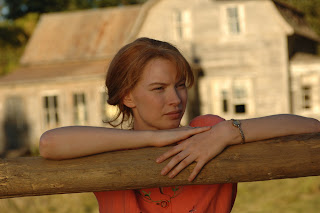 his alcoholism, they replace Hauser with his real-life father, veteran character actor Wings Hauser. It’s a small touch, but that attention to detail really helps the continuity, and makes the world Skogland crafts seem all the more real.
My only real gripe with The Stone Angel is that it drags a bit in places, though that could be a bias on my part, as this isn’t really my type of movie, generally speaking. I went into this review pretty reluctantly, but I was pleasantly surprised that not only did The Stone Angel hold my attention, it actually sucked me in in relatively short order. It’s a good movie, and if this is the kind of movie that sounds like your thing, or you’re a fan of Margaret Laurence’s novel, definitely check it out.
GRADE: B
THE EXTRAS
The Stone Angel DVD has literally no extras, not even a trailer. It’s a shame really, as I for one am very interested in the process of adapting a work from one medium to another and the challenges that can present (especially for such a well-known book like The Stone Angel), so a featurette on that would have been nice. As it is, it’s the barest of bare-bones DVDs, which is too bad.
The Stone Angel is an adaptation of the novel by Canadian author Margaret Laurence (a couple of her books, including The Stone Angel, are commonly studied in school
 up here). It’s a Canadian film, which is appropriate given Laurence’s iconic status in the field of Canadian literature, and played at the 2007 Toronto International Film Festival to considerable hype. I’d expected to be bored silly by what I assumed would be a pretty standard chick flick – the story follows an old woman reflecting on her life in rural Manitoba, specifically in from the ‘40s through the ‘60s – but I found myself getting quite engaged by the film, and by the end, even moved.
The film stars Oscar-winner Ellen Burstyn as Hagar Shipley, a 90-year-old woman with a rickety relationship with her grown son (played by the excellent American character actor Dylan Baker) and an even worse one with his wife (Sheila McCarthy). After a particularly nasty fight with him one night, she hops a bus out to the small Manitoba town where she grew up, and ends up spending the night in the burned-out ruins of her old home, her mind drifting back and forth from the present to the past. While Hagar is still whip-smart at her advanced age, she’s also showing signs of dementia, occasionally becoming confused about who she’s talking to or what year it is. It’s here that the film (and the novel as well, I assume; I’ve never read it) strikes an interesting balance between showing that Hagar is still as smart-alecky and stubborn as she was when she was young, but she’s in the final years of her life and her mind and body are well on their way to breaking down.
Hagar is shown to be headstrong and stubborn, as well as something of an iconoclast. Typically in movies this means she sass-talks everyone and is shown to be smarter than almost everyone and ultimately in the right (even if those around her don’t see it). But in The Stone Angel, Hagar’s personality brings her i
 nto conflict with those closest to her (sometimes rightly, sometimes not). As a young woman, she alienates her widowed father by marrying a local rancher instead of trying to marry into high society like he planned; her marriage eventually breaks down; and throughout her older adult life her relationship with her two sons grows more and more strained. Hell, she’s even got a beef with the entire town – at the time of her father’s death, he still carried enough of a grudge against her that he leaves his considerable fortune to the entire town in his will rather than pass it on to her. Hagar’s is a lifetime of pushing peoples’ buttons – sometimes deliberately, sometimes not – and The Stone Angel shows exactly how she pays the price for it.
The Stone Angel was directed by Canadian filmmaker Kari Skogland, who bathes much of the film in a rich golden light. The Canadian Prairies have been captured brilliantly on film before – a lot of American westerns are filmed there, including the similarly gorgeous The Assassination of Jesse James by the Coward Robert Ford – and Skogland and cinematorgrapher Bobby Bukowski photograph the landscape beautifully. Telling a story that’s constantly jumping across time can sometimes lead to confusing results (in The Stone Angel the story sometimes skips ahead a few years within what’s already technically a flashback), but Skogland manages to keep everything under control, and uses some nice transition techniques between time periods.
Skogland is also helped by a cast of uniformly good-to-great actors. Burstyn’s an Oscar winner and multiple nominee, and she does excellent work in The Stone Angel, with her performance ranging from heartbreaking to hilarious. Cole Hauser is also great as Hagar’s husband, Bram. I’ve been a fan of his for years in the small roles he’s had in larger movies (he’s great as the shady bounty hunter butting heads with Vin Diesel in the sci-fi/horror flick Pitch Black, the first – and best – entry in Diesel’s aborted Riddick saga, and steals many a scene in The Break-Up as one of Vince Vaughn’s brothers), but this is the first time I’ve seen him in a role this large, and he’s quite good. He’s handsome enough that you can see how Hagar fell for him when she meets him at a local dance one night, but he has enough of an edge to him that when things begin to go wrong in their marriage – he’s as headstrong as she is, and cares even less than she does what the rest of society thinks – it’s not a complete shock. Ellen Page shows up to do some good work as well, though she’s really only in a couple of scenes (as the girlfriend of Hagar’s younger son), despite her prominence on the DVD cover.
The casting itself in The Stone Angel is very well done as well. Christine Horne, who plays Hagar as a young woman, in addition to being a very good actress, looks remarkably like a young version of Ellen Burstyn. She invests young Hagar with an intelligence and fire (which makes her stand out even more in small-town Manitoba of the ‘40s and ‘50s than it would now) that Burstyn provides several glimpses of in her later years. And one very minor detail really impressed me (and less geeky viewers will probably not miss, but I caught it and it kind of blew my mind a little) – when Hagar visits her aging ex-husband, now in ill health because of
 his alcoholism, they replace Hauser with his real-life father, veteran character actor Wings Hauser. It’s a small touch, but that attention to detail really helps the continuity, and makes the world Skogland crafts seem all the more real.
My only real gripe with The Stone Angel is that it drags a bit in places, though that could be a bias on my part, as this isn’t really my type of movie, generally speaking. I went into this review pretty reluctantly, but I was pleasantly surprised that not only did The Stone Angel hold my attention, it actually sucked me in in relatively short order. It’s a good movie, and if this is the kind of movie that sounds like your thing, or you’re a fan of Margaret Laurence’s novel, definitely check it out.
GRADE: B
THE EXTRAS
The Stone Angel DVD has literally no extras, not even a trailer. It’s a shame really, as I for one am very interested in the process of adapting a work from one medium to another and the challenges that can present (especially for such a well-known book like The Stone Angel), so a featurette on that would have been nice. As it is, it’s the barest of bare-bones DVDs, which is too bad.
Labels: Canadian cinema, DVD review, Theme weeks
¶ 10:04 AM 0 Comments
Wednesday, October 22, 2008
DVD Review: Young People F***ing
THE MOVIE
Young People F***ing is a Canadian romantic comedy that puts me in a bit of an awkward position. See, it's good – really, really good – but it was also co-written by and co-stars a good buddy of mine I've known since high school, Aaron Abrams, and the standout performance (in my opinion, at least) is from one of my oldest friends, Ennis Esmer. Now, I realize it pretty self-indulgent f or me to even mention this, as if I'm trying to impress you with my film-industry connections (I’m not, believe me, as these two guys, talented as they are, are the sum total), but rather because I went to journalism school and believe in full disclosure, and if I'm about to go on at length about how great Young People F***ing is, I think you should know these facts. But something else you should know about me is that I am known among just about all of my friends as a bit of a jerk, largely (but not exclusively) because I'm notoriously bad at lying to people about things that it's culturally accepted we're all supposed to lie about. Which is really a roundabout way of saying that if Young People F***ing was actually a bad or even just mediocre movie, I'd say as much. But the thing is, it's the best romantic and/or sex comedy (it's a bit of both) I've seen, probably ever.
A quick note about the title: as I understand it, it was initially a working title of sorts, as Abrams and co-writer Martin Gero (who also directed the movie) called it that because Young People F***ing is really what the movie is about, and they couldn’t think of anything better, but planned on changing it to something more appropriate down the line. But people (producers, distributors, etc.) seemed to like it, and it just sorta stuck. So while the title does obviously turn heads, it’s not a cynical, attention-grabbing sort of thing so much as it is just the filmmakers being frank about what their movie’s about.
Young People F***ing, released in America as simply Y.P.F., was the centre of a mini-controversy surrounding government film grants here in Canada. See, just about every Canadian movie gets some amount of public financing, and eventually some bureaucrat or pundit or an other realized there was a movie called Young People F***ing that received some amount of tax dollars. The flap over Y.P.F. is due to the title (anyone renting it to see some cheap, softcore thrills will be sorely disappointed) and the very frank – and hilarious – way the characters talk about sex. It's very much like Kevin Smith's Clerks, which got all sorts of attention back in 1994 for being the first movie to get slapped with an NC-17 rating for language alone. While Y.P.F. does include some nudity in it, it's nothing more than you'll see in your average R-rated action or comedy flick. It's also the most genuinely adult (and I mean that as in "mature," not "euphemism for pornography") comedy about sex and relationships I've seen. Judd Apatow's The 40-Year-old Virgin, Knocked Up and Forgetting Sarah Marshall all resonated with audiences largely (in my opinion, at least) because, at their core, they present relationships in a realistic way people can relate to. Y.P.F. is similar, except that it strips away the sillier plot points of more high-concept, mainstream Hollywood comedies to focus exclusively on the more realistic relationship stuff, with the more “out there” situations still taking place within the realm of reality.
The plot of Y.P.F. is simple, though the film’s construction is not. It follows four unrelated couples (and one threesome) – The Friends, The Couple, The Exes, The First Date and The Roommates (that's the threesome) over one night, with each encounter divided into Prelude, Foreplay, Sex, Interlude and Orgasm and Afterglow. If any of the cou ples know each other, it's not mentioned; Y.P.F. is essentially an anthology movie, but all the separate stories are so connected, thematically, that you'll hardly notice. Just about all the stories are relatable to most people in one way or another, whether it's the inherent awkwardness of a platonic friends finally consummating years of unrequited feelings or the...other kind of inherent awkwardness of a threesome between a guy, his girlfriend and his roommate he can barely stand. Each story is simultaneously hilarious and also filled with "oh wow, that totally happened to me” moments. (For me, different aspects of The Exes and The Couple hit close to home, but that's the sort of detail that's different for everyone, sort of like how five different people can take five different meanings from a song.)
Y.P.F. is the feature film debut of director Martin Gero, a veteran writer/producer on the Canadian-made cult sci-fi series Stargate: Atlantis. Obviously that show is a far cry from a decidedly grown-up sex comedy, and romantic comedies aren't really the greatest showcase for flashy filmmaking tricks, but Gero does a good job with Y.P.F. Considering he’s got 11 characters in four different stories, with each of those stories in turn divided into five parts, Y.P.F. easily could have gotten too confusing or complicated for its own good, but Gero keeps everything bopping along at a nice pace, staying with each story for enough time to keep the viewer engaged, but not so long as the other stories are forgotten. Gero co-wrote the screenplay with actor Abrams (the male half of The Friends), and the two of them show more genuine understanding of relationships than any movie I can recall seeing. Gero's described Y.P.F. as a sex comedy for people who've actually had sex, and I couldn't have put it better myself. This isn't a goofy sex comedy aimed at randy teens, or a romantic comedy where the romance isn't consummated until offscreen after the couple gets together in the final scene. And for all the attention the film’s received for its alleged crudeness – in addition to the aforementioned controversy here in Canada about public funding for the film industry, America’s MPAA also had their share of issues with the movie – Y.P.F. also packs some real heart to it, and also has a lot of relevant and genuinely interesting things to say about modern relationships and the differences between love and lust.
The cast of Y.P.F. does great work across the board. Everyone gets funny stuff to do, though some more than others – arguably the film’s funniest performance belongs to Esmer as Gord, the gluttonous instigator of the threesome (who – SPOILER ALERT – is really more of a cheerleader than an active participant), and Peter Oldring is great as his almost-mute roommate, Dave. But overall this is a crop of very talented young actors all of whom have bright futures ahead of them if their performances here are any indication.
Young People F***ng is a movie about relationships aimed at people who've actually been in them themselves, and know how weird and awkward and sex and romance and all that other stuff actually be. None of the characters get exactly what they expected going into their respective couplings, and that's far more realistic than any amount of semen in Ben Stiller's hair. If you dig on romantic comedies and you’ve got a taste for ribald humour, Young People F***ing is about as good as it gets. Very highly recommended.
GRADE: A-
THE EXTRAS
The lone extra on the standard Young People F***ing DVD – at least the Canadian version – is audio commentary from Abrams and Gero. I believe the American DVD is strictly a bare-bones affair (that’s what Amazon.ca is for), and I believe the Canadian Blu-Ray version has some other extras on it as well. Abrams and Gero are both extremely funny dudes, and they're a lot of fun to listen to, discussing everything from the ins and outs of production to great commentaries in DVD history. More extras on the standard DVD would have been nice, but overall the movie itself is good enough that it’s a minor gripe. Young People F***ing is a great little film that deserves your attention. Seek it out.
Young People F***ing is a Canadian romantic comedy that puts me in a bit of an awkward position. See, it's good – really, really good – but it was also co-written by and co-stars a good buddy of mine I've known since high school, Aaron Abrams, and the standout performance (in my opinion, at least) is from one of my oldest friends, Ennis Esmer. Now, I realize it pretty self-indulgent f
 or me to even mention this, as if I'm trying to impress you with my film-industry connections (I’m not, believe me, as these two guys, talented as they are, are the sum total), but rather because I went to journalism school and believe in full disclosure, and if I'm about to go on at length about how great Young People F***ing is, I think you should know these facts. But something else you should know about me is that I am known among just about all of my friends as a bit of a jerk, largely (but not exclusively) because I'm notoriously bad at lying to people about things that it's culturally accepted we're all supposed to lie about. Which is really a roundabout way of saying that if Young People F***ing was actually a bad or even just mediocre movie, I'd say as much. But the thing is, it's the best romantic and/or sex comedy (it's a bit of both) I've seen, probably ever.
A quick note about the title: as I understand it, it was initially a working title of sorts, as Abrams and co-writer Martin Gero (who also directed the movie) called it that because Young People F***ing is really what the movie is about, and they couldn’t think of anything better, but planned on changing it to something more appropriate down the line. But people (producers, distributors, etc.) seemed to like it, and it just sorta stuck. So while the title does obviously turn heads, it’s not a cynical, attention-grabbing sort of thing so much as it is just the filmmakers being frank about what their movie’s about.
Young People F***ing, released in America as simply Y.P.F., was the centre of a mini-controversy surrounding government film grants here in Canada. See, just about every Canadian movie gets some amount of public financing, and eventually some bureaucrat or pundit or an
 other realized there was a movie called Young People F***ing that received some amount of tax dollars. The flap over Y.P.F. is due to the title (anyone renting it to see some cheap, softcore thrills will be sorely disappointed) and the very frank – and hilarious – way the characters talk about sex. It's very much like Kevin Smith's Clerks, which got all sorts of attention back in 1994 for being the first movie to get slapped with an NC-17 rating for language alone. While Y.P.F. does include some nudity in it, it's nothing more than you'll see in your average R-rated action or comedy flick. It's also the most genuinely adult (and I mean that as in "mature," not "euphemism for pornography") comedy about sex and relationships I've seen. Judd Apatow's The 40-Year-old Virgin, Knocked Up and Forgetting Sarah Marshall all resonated with audiences largely (in my opinion, at least) because, at their core, they present relationships in a realistic way people can relate to. Y.P.F. is similar, except that it strips away the sillier plot points of more high-concept, mainstream Hollywood comedies to focus exclusively on the more realistic relationship stuff, with the more “out there” situations still taking place within the realm of reality.
The plot of Y.P.F. is simple, though the film’s construction is not. It follows four unrelated couples (and one threesome) – The Friends, The Couple, The Exes, The First Date and The Roommates (that's the threesome) over one night, with each encounter divided into Prelude, Foreplay, Sex, Interlude and Orgasm and Afterglow. If any of the cou
 ples know each other, it's not mentioned; Y.P.F. is essentially an anthology movie, but all the separate stories are so connected, thematically, that you'll hardly notice. Just about all the stories are relatable to most people in one way or another, whether it's the inherent awkwardness of a platonic friends finally consummating years of unrequited feelings or the...other kind of inherent awkwardness of a threesome between a guy, his girlfriend and his roommate he can barely stand. Each story is simultaneously hilarious and also filled with "oh wow, that totally happened to me” moments. (For me, different aspects of The Exes and The Couple hit close to home, but that's the sort of detail that's different for everyone, sort of like how five different people can take five different meanings from a song.)
Y.P.F. is the feature film debut of director Martin Gero, a veteran writer/producer on the Canadian-made cult sci-fi series Stargate: Atlantis. Obviously that show is a far cry from a decidedly grown-up sex comedy, and romantic comedies aren't really the greatest showcase for flashy filmmaking tricks, but Gero does a good job with Y.P.F. Considering he’s got 11 characters in four different stories, with each of those stories in turn divided into five parts, Y.P.F. easily could have gotten too confusing or complicated for its own good, but Gero keeps everything bopping along at a nice pace, staying with each story for enough time to keep the viewer engaged, but not so long as the other stories are forgotten. Gero co-wrote the screenplay with actor Abrams (the male half of The Friends), and the two of them show more genuine understanding of relationships than any movie I can recall seeing. Gero's described Y.P.F. as a sex comedy for people who've actually had sex, and I couldn't have put it better myself. This isn't a goofy sex comedy aimed at randy teens, or a romantic comedy where the romance isn't consummated until offscreen after the couple gets together in the final scene. And for all the attention the film’s received for its alleged crudeness – in addition to the aforementioned controversy here in Canada about public funding for the film industry, America’s MPAA also had their share of issues with the movie – Y.P.F. also packs some real heart to it, and also has a lot of relevant and genuinely interesting things to say about modern relationships and the differences between love and lust.
The cast of Y.P.F. does great work across the board. Everyone gets funny stuff to do, though some more than others – arguably the film’s funniest performance belongs to Esmer as Gord, the gluttonous instigator of the threesome (who – SPOILER ALERT – is really more of a cheerleader than an active participant),
 and Peter Oldring is great as his almost-mute roommate, Dave. But overall this is a crop of very talented young actors all of whom have bright futures ahead of them if their performances here are any indication.
Young People F***ng is a movie about relationships aimed at people who've actually been in them themselves, and know how weird and awkward and sex and romance and all that other stuff actually be. None of the characters get exactly what they expected going into their respective couplings, and that's far more realistic than any amount of semen in Ben Stiller's hair. If you dig on romantic comedies and you’ve got a taste for ribald humour, Young People F***ing is about as good as it gets. Very highly recommended.
GRADE: A-
THE EXTRAS
The lone extra on the standard Young People F***ing DVD – at least the Canadian version – is audio commentary from Abrams and Gero. I believe the American DVD is strictly a bare-bones affair (that’s what Amazon.ca is for), and I believe the Canadian Blu-Ray version has some other extras on it as well. Abrams and Gero are both extremely funny dudes, and they're a lot of fun to listen to, discussing everything from the ins and outs of production to great commentaries in DVD history. More extras on the standard DVD would have been nice, but overall the movie itself is good enough that it’s a minor gripe. Young People F***ing is a great little film that deserves your attention. Seek it out.
Labels: Canadian cinema, comedy, DVD review, Theme weeks
¶ 8:58 AM 0 Comments
Thursday, August 28, 2008
Hard Core Logo sequel(s)
In my review of Bruce McDonald’s unique drama The Tracey Fragments, I spent a paragraph gushing about how much I love his 1996 “rock n’ road” movie Hard Core Logo. It’s one of my all-time favourites, though don’t let the marketing lines referencing Spinal Tap on the American DVD cover fool you – it’s not a comedy. True, it’s a “mockumentary” about a rock band, and there are parts in it that are incredibly funny, but the film is really about things like friendship, betrayal, anger and the family-like bond between bandmates. It’s a brilliant little movie, one I love dearly, so I was pretty stoked when I read that McDonald is planning a sequel, which he hopes to start shooting next year. (I should mention that there’s some spoiler-type information about the original in the article.) And not only one; McDonald is hoping to create a four- or even five-film “juggernaut” out of it.
One sequel to Hard Core Logo would be awesome enough, but three, possibly four? Granted, they may not live up the first, and with the careers of lead actors Hugh Dillon and Callum Keith Rennie currently in high gear – Dillon currently stars in two Canadian TV dramas, and hosts a third show about comic books on IFC Canada, and Rennie is a regular on Battlestar Galactica – McDonald says making sure everyone’s schedule matches up will probably be a challenge. But hey, if George Lucas, Steven Spielberg and Harrison Ford can get back together for another Indiana Jones movie, this should be easy. And I’m sure McDonald could make four kickass Hard Core Logo sequels for about the same amount they paid Ford's stand-in on the Crystal Skull set.
Below is the original trailer for Hard Core Logo. If you’re into rock movies, it's worth your time. It’s the best one I’ve seen.
One sequel to Hard Core Logo would be awesome enough, but three, possibly four? Granted, they may not live up the first, and with the careers of lead actors Hugh Dillon and Callum Keith Rennie currently in high gear – Dillon currently stars in two Canadian TV dramas, and hosts a third show about comic books on IFC Canada, and Rennie is a regular on Battlestar Galactica – McDonald says making sure everyone’s schedule matches up will probably be a challenge. But hey, if George Lucas, Steven Spielberg and Harrison Ford can get back together for another Indiana Jones movie, this should be easy. And I’m sure McDonald could make four kickass Hard Core Logo sequels for about the same amount they paid Ford's stand-in on the Crystal Skull set.
Below is the original trailer for Hard Core Logo. If you’re into rock movies, it's worth your time. It’s the best one I’ve seen.
Labels: Bruce McDonald, Canadian cinema, Mockumentary, Movie news
¶ 11:41 AM 0 Comments
Tuesday, July 29, 2008
DVD Review: The Tracey Fragments
THE MOVIE
“My name is Tracey Berkowitz, 15. Just a normal girl who hates herself.”
The Tracey Fragments is a weird little Canadian indie movie from director Bruce McDonald and starring Canadian Oscar nominee Ellen Page. Not that Canada produces the equivalent of big studio movie s, but there’s also a clear indie aesthetic at play here. (Also, even if she fades into obscurity, Page will be referred to in Canada as “Canadian Oscar nominee Ellen Page” until the end of time; we Canadians are insecure like that.)
The film is based on a novel by Maureen Medved, who also penned the screenplay. It opens with 15-year-old Tracey Berkowitz sitting on the bus, naked except for a shower curtain. Exactly how she got there and what happened to her is the story of the film. It’s an incredibly effective premise, in that Tracey’s situation (I won’t say “predicament” because she seems incredibly calm and unfazed considering she’s a 15-year-old girl riding a city bus at night wearing only a shower curtain) immediately made me eager to find out just what happened. (The plot involves her desperately searching for her kid brother, who’s been missing for a few days after she hypnotized him into thinking he was a dog.) While the concept of starting a movie in a compellingly strange place in the story and building the film around the after-the-fact explanation isn’t a new concept, McDonald does a lot of interesting things with it.
Bruce McDonald, by the way, directed one of my all-time favourite movies, an awesome little 1996 rock and roll movie called Hard Core Logo, about a fictional semi-obscure Canadian punk band reuniting for a tour across the country playing dive bars and scummy clubs. It stars musician-turned-actor Hugh Dillon in what I believe was his first acting role (he absolutely destroys it; he’s since carved out a nice little career for himself as a character actor, and can currently be seen in the Canadian-produced left-field hit cop drama Flashpoint, not to be confused with the awesome kung fu movie Flash Point – my review of which is here) and character actor Callum Keith Rennie (probably best known now as the tricky blond Cylon Leoben on Battlestar Galactica). Hard Core Logo doesn’t have a whole lot to do with The Tracey Fragments, but I had to mention it just because it’s a great movie. I’m not sure what its DVD status is at this point – I got a copy from a Canadian DVD company when it was reissued several years ago – but if you’re into music movies, Hard Core Logo comes with my highest possible recommendation.
Anyway, back to The Tracey Fragments. McDonald was apparently inspired by the title to craft a very unique film, breaking the screen up into literal fragments to show different angles of scenes (both literally and figuratively). Medved says on the DVD that her book was very subjective, being written from the perspective of a 15-year-old girl, and McDonald’s vision does a great job of capturing the unreliable narrator aspect of the text. Some of the scenes sh ow Tracey’s gritty reality, while others are clearly fantasy, and many more exist somewhere in between. Typically I get annoyed when a movie plays fast and loose with what’s really happening and what isn’t, but I thought the technique worked well in The Tracey Fragments. And while I certainly won’t spoil any plot twists, I will say that McDonald never leaves any of the important stuff ambiguous. I have a soft spot for movies that seem impenetrable at first but reward the viewer for actually paying attention (see also: David Mamet’s Spartan, a movie I will fawn over in a future post), and while I’ve read that some people found McDonald’s visual style here hard to follow, I had no problems comprehending the events on the screen.
McDonald also pulls out some more traditional (and fun) filmmaking tricks, like including a brilliant fake-opening-credits sequence for the movie about Tracey’s life that plays in her head (including credits for “F***head Bully #1 and #2,” “Some Crazy Lady” and “That Knockout Bitch Debbie Dodge”). Tracey’s the victim of much taunting in school, and lives a vivid fantasy life as a result. When a cute new boy starts school, she imagines him riding a motorcycle through the halls, cigarette dangling from his lips, as he rescues her from her classroom tormentors. I haven’t been a teenager for a decade now, but high school life portrayed in The Tracey Fragments feels a lot closer to the angst and the weird, unfocused anguish of adolescence than any so-called “teen” movie I can recall seeing any time recently, but maybe that says more about me than it does about movies. Not for me to judge, I guess.
But the visual flourishes are nothing compared to the real draw of The Tracey Fragments, and that’s Ellen Page’s amazing performance. Page is, hands down, the best young actress out there right now, and her work in The Tracey Fragments is something to behold. Tracey's the sort of complex female character we don’t see enough in movies; rather than being a one-note “tough girl” or tomboy or an embittered geek, she’s simultaneously cynical and strangely naïve. It’s a hell of a tricky tightrope to walk, but Page pulls if off with the gusto of a seasoned vet. Not that I’m the first person to say this, but Page definitely looks to be one of those once-in-a-generation talents, and this (along with Hard Candy – rent it if you dare) is the best work I’ve seen her do.
The Tracey Fragments had me pinned to my couch, and at no point during its wonderfully economical 77-minute running time did I have the slightest idea what was going to happen next. And for a movie like this, that’s the highest compliment I could pay it.
GRADE: B+
THE EXTRAS
The Tracey Fragments DVD is pretty spare – a commentary from McDonald and/or Page (the latter, I assume, would be a bit of a challenge, as Page’s stock has risen quite a bit since this film was completed thanks to Juno) would have been a nice touch. There’s a brief making-of featurette that runs less than 10 minutes and boasts on-set interviews with McDonald, Page and others, but it’s not long enough to really get into any detail about the film. Which is a shame, because it’s the kind of movie that really would benefit from some more in-depth bonus features.
The only other extra (aside from a photo gallery) is an interesting item called ‘Tracey: Re-Fragmented.’ To promote the film, McDonald and company released digital files of various scenes from the movie on the web for users to play around with to make their own short films or trailers. Five are included, and the winner’s trailer is actually considerably better than the film’s official trailer (which is also included). It’s a cool little feature to include on the DVD, reminiscent of a similar short-film contest on the Diary of the Dead DVD (read my review here). Overall it’s a pretty sparse disc, but The Tracey Fragments is recommended nonetheless. Sometimes a good movie’s enough.
“My name is Tracey Berkowitz, 15. Just a normal girl who hates herself.”
The Tracey Fragments is a weird little Canadian indie movie from director Bruce McDonald and starring Canadian Oscar nominee Ellen Page. Not that Canada produces the equivalent of big studio movie
 s, but there’s also a clear indie aesthetic at play here. (Also, even if she fades into obscurity, Page will be referred to in Canada as “Canadian Oscar nominee Ellen Page” until the end of time; we Canadians are insecure like that.)
The film is based on a novel by Maureen Medved, who also penned the screenplay. It opens with 15-year-old Tracey Berkowitz sitting on the bus, naked except for a shower curtain. Exactly how she got there and what happened to her is the story of the film. It’s an incredibly effective premise, in that Tracey’s situation (I won’t say “predicament” because she seems incredibly calm and unfazed considering she’s a 15-year-old girl riding a city bus at night wearing only a shower curtain) immediately made me eager to find out just what happened. (The plot involves her desperately searching for her kid brother, who’s been missing for a few days after she hypnotized him into thinking he was a dog.) While the concept of starting a movie in a compellingly strange place in the story and building the film around the after-the-fact explanation isn’t a new concept, McDonald does a lot of interesting things with it.
Bruce McDonald, by the way, directed one of my all-time favourite movies, an awesome little 1996 rock and roll movie called Hard Core Logo, about a fictional semi-obscure Canadian punk band reuniting for a tour across the country playing dive bars and scummy clubs. It stars musician-turned-actor Hugh Dillon in what I believe was his first acting role (he absolutely destroys it; he’s since carved out a nice little career for himself as a character actor, and can currently be seen in the Canadian-produced left-field hit cop drama Flashpoint, not to be confused with the awesome kung fu movie Flash Point – my review of which is here) and character actor Callum Keith Rennie (probably best known now as the tricky blond Cylon Leoben on Battlestar Galactica). Hard Core Logo doesn’t have a whole lot to do with The Tracey Fragments, but I had to mention it just because it’s a great movie. I’m not sure what its DVD status is at this point – I got a copy from a Canadian DVD company when it was reissued several years ago – but if you’re into music movies, Hard Core Logo comes with my highest possible recommendation.
Anyway, back to The Tracey Fragments. McDonald was apparently inspired by the title to craft a very unique film, breaking the screen up into literal fragments to show different angles of scenes (both literally and figuratively). Medved says on the DVD that her book was very subjective, being written from the perspective of a 15-year-old girl, and McDonald’s vision does a great job of capturing the unreliable narrator aspect of the text. Some of the scenes sh
 ow Tracey’s gritty reality, while others are clearly fantasy, and many more exist somewhere in between. Typically I get annoyed when a movie plays fast and loose with what’s really happening and what isn’t, but I thought the technique worked well in The Tracey Fragments. And while I certainly won’t spoil any plot twists, I will say that McDonald never leaves any of the important stuff ambiguous. I have a soft spot for movies that seem impenetrable at first but reward the viewer for actually paying attention (see also: David Mamet’s Spartan, a movie I will fawn over in a future post), and while I’ve read that some people found McDonald’s visual style here hard to follow, I had no problems comprehending the events on the screen.
McDonald also pulls out some more traditional (and fun) filmmaking tricks, like including a brilliant fake-opening-credits sequence for the movie about Tracey’s life that plays in her head (including credits for “F***head Bully #1 and #2,” “Some Crazy Lady” and “That Knockout Bitch Debbie Dodge”). Tracey’s the victim of much taunting in school, and lives a vivid fantasy life as a result. When a cute new boy starts school, she imagines him riding a motorcycle through the halls, cigarette dangling from his lips, as he rescues her from her classroom tormentors. I haven’t been a teenager for a decade now, but high school life portrayed in The Tracey Fragments feels a lot closer to the angst and the weird, unfocused anguish of adolescence than any so-called “teen” movie I can recall seeing any time recently, but maybe that says more about me than it does about movies. Not for me to judge, I guess.
But the visual flourishes are nothing compared to the real draw of The Tracey Fragments, and that’s Ellen Page’s amazing performance. Page is, hands down, the best young actress out there right now, and her work in The Tracey Fragments is something to behold. Tracey's the sort of complex female character we don’t see enough in movies; rather than being a one-note “tough girl” or tomboy or an embittered geek, she’s simultaneously cynical and strangely naïve. It’s a hell of a tricky tightrope to walk, but Page pulls if off with the gusto of a seasoned vet. Not that I’m the first person to say this, but Page definitely looks to be one of those once-in-a-generation talents, and this (along with Hard Candy – rent it if you dare) is the best work I’ve seen her do.
The Tracey Fragments had me pinned to my couch, and at no point during its wonderfully economical 77-minute running time did I have the slightest idea what was going to happen next. And for a movie like this, that’s the highest compliment I could pay it.
GRADE: B+
THE EXTRAS
The Tracey Fragments DVD is pretty spare – a commentary from McDonald and/or Page (the latter, I assume, would be a bit of
 a challenge, as Page’s stock has risen quite a bit since this film was completed thanks to Juno) would have been a nice touch. There’s a brief making-of featurette that runs less than 10 minutes and boasts on-set interviews with McDonald, Page and others, but it’s not long enough to really get into any detail about the film. Which is a shame, because it’s the kind of movie that really would benefit from some more in-depth bonus features.
The only other extra (aside from a photo gallery) is an interesting item called ‘Tracey: Re-Fragmented.’ To promote the film, McDonald and company released digital files of various scenes from the movie on the web for users to play around with to make their own short films or trailers. Five are included, and the winner’s trailer is actually considerably better than the film’s official trailer (which is also included). It’s a cool little feature to include on the DVD, reminiscent of a similar short-film contest on the Diary of the Dead DVD (read my review here). Overall it’s a pretty sparse disc, but The Tracey Fragments is recommended nonetheless. Sometimes a good movie’s enough.
Labels: Bruce McDonald, Canadian cinema, DVD review
¶ 12:53 PM 0 Comments


