People Tell Me I Look Like Han Solo.
Friday, October 30, 2009
Under the Radar: Near Dark
It’s been too long since I’ve done an Under the Radar entry, and given that Halloween is tomorrow, I thought I’d spotlight my favorite vampire movie ever (w hich I’ve mentioned here more than once), the 1987 cult classic Near Dark. It was directed by the great Kathryn Bigelow (one of my favorite directors ever; she also made Point Break and this past summer’s brilliant The Hurt Locker), and it’s one of the most unique vampire movies I’ve ever seen. It’s also scary as hell and totally awesome.
Near Dark is, in Bigelow’s words, a vampire western. Except it’s set in the modern day (well, 1987), so the western aspects come from the setting and the feel rather than the time period. It’s set in the American southwest, and follows a young country boy named Caleb (Adrian Pasdar, who’d go on to play Nathan in Heroes) who meets a beautiful, mysterious girl named Mae (Jenny Wright) while out with his friends one night. Intrigued, he pursues her, and she seems to return his interest, but pretty soon she’s making cryptic statements about still being around in a billion years when the light leaving distant stars reaches the Earth and imploring him to drive her home before sunrise. In an apparent fit of passion, she bites him on the neck, and soon Caleb is trapped, as the old Marvel comics covers used to say, in a world he never made. Not long after Mae’s love nibble, Caleb falls in with the gang she runs with, led by the menacing Jesse (Lance Henriksen), the father figure of a little family of nomadic vampires. The mother figure is his woman, Diamondback (Jenette Goldstein), and their “kids” are Mae, the hot-headed psychopath Severen (Bill Paxton), and Homer (Joshua John Miller), an adult man trapped in a child’s body.
It may seem almost gimmicky now, but Near Dark is a vampire movie in which nobody ever says the word “vampire,” and not a single fang is ever glimpsed. Instead of the usual vampire mythology, Bigelow’s bloodsuckers are dirty, vicious predators, in contrast to the more traditional European vision of vampires as sleek, seductive charmers. By melding the standard vampire-romance plot with iconic western imagery, Near Dark becomes a distinctly American vampire tale, and, with the exception of Wright’s Mae (who actually is beautiful and seductive), the vamps in Near Dark are more like a gang of outlaws from a western, with ragged clothes, filthy faces, plenty of guns and a serious hate-on for law enforcement. (There’s even a sequence where the gang holes up in a small motel room for a shootout with police.)
Near Dark is an interesting reversal of what has become the standard “innocent human girl falls for dreamy vampire hunk” premise. The inversion benefits largely from Wright, who is astonishingly gorgeous; I might consider going through the hell Caleb suffers through in the movie for a shot with her.
But as much as Near Dark hits many of the usual vampire-movie notes with its pair of star-crossed lovers and lead character torn between the human and vampire worlds, it’s also scary as hell, but not in a jump-scare, monster-movie way. Near Dark is scary more in the way really tense crime movies are scary, with the threat of random, brutal violence always looming. The best example is the scene midway through the film (arguably the movie's centerpiece) where Jesse’s gang, with Caleb the new recruit in tow, enters a dusty redneck bar. From the second the vampires enter the frame, you know it’s going to get ugly, but Bigelow ratchets up the tension very deliberately, at an almost agonizingly slow pace, and the result is chilling. The terrified bystanders can only watch helplessly as the vampires casually kill everyone inside one by one.
In keeping with its western vibe, Near Dark veers into action-movie territory as the story progresses, particularly the Terminator-esque showdown between Caleb and Severen in the final act. That’s not a problem for me at all – Bigelow’s one of the best action directors to ever pick up a camera – but viewers looking for a movie about sexy young vampires making goo-goo eyes at each other for 90 minutes might be put off by all the gunplay and chases and explosions.
But an original idea and brilliant direction can only take you so far if you don’t have actors bringing it. Adrian Pasdar is great as Caleb, who has a nice arc going from wide-eyed country boy to vampire outlaw, and the scenes where he’s starting to enjoy his new life are particularly good; I could watch a whole movie about this band of bloodsuckers criss-crossing the country causing trouble. Jenny Wright doesn’t have to do that much other than look hot, but she’s pretty good at that. The only problem with her character is that Mae is played with such an inherent decency and goodness that it’s a little difficult to understand how she’s managed to run with this gang of killers for as long as she has.
It’s in the gang of evil vampires, though, that the casting of Near Dark really shines. Lance Henriksen in particular is fantastic and terrifying as Jesse, the leader, but it comes more from the feeling that he’d rip out your throat as soon as look at you, and his being a vampire doesn’t really have much to do with it. It’s all in Henriksen’s attitude and the way he plays the role. (I’ve been a huge fan of Henriksen for years; I think he’s one of the best character actors out there and few are better at playing villains.) Bill Paxton is also a treat; he gets the more flashy, scenery-chewing work as the playfully brutal Severen. And Jenette Goldstein manages to make Diamon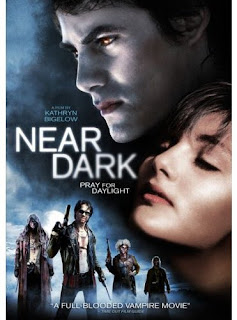 dback hard-edged and brassy but still give her an odd, motherly quality as well. (A big reason these three work so well together is that Bigelow cast them essentially right off the set of James Cameron’s Aliens, where they all played space marines and endured a pre-production boot camp, and between that and the actual shoot, they developed a camaraderie that Near Dark benefits from tremendously.) And while Near Dark may not have invented the idea, it was the first vampire movie I’d ever seen that looked at tragic concept of the vampire kid who’s actually an adult trapped in a child’s body, and Joshua John Miller brings a world-weariness to Homer that most child actors couldn’t come close to.
Near Dark has been a popular cult movie for years, and the two-disc Anchor Bay DVD set I managed to get my hands on years ago has some excellent extras on it, including commentary from Bigelow, deleted scenes and a great retrospective making-of documentary. Lionsgate has since repackaged the Near Dark DVD to capitalize on the success of Twilight, basically making the cover resemble the poster for Twilight as much as possible. It’s sort of a shame, but the movie itself is great, and if aping a better-known, more recent hit film will drive more people to see this awesome little gem of a movie, I can live with that. If you want to see a truly original, dark, violent and sexy vampire movie, Near Dark comes with my highest possible recommendation.

 hich I’ve mentioned here more than once), the 1987 cult classic Near Dark. It was directed by the great Kathryn Bigelow (one of my favorite directors ever; she also made Point Break and this past summer’s brilliant The Hurt Locker), and it’s one of the most unique vampire movies I’ve ever seen. It’s also scary as hell and totally awesome.
Near Dark is, in Bigelow’s words, a vampire western. Except it’s set in the modern day (well, 1987), so the western aspects come from the setting and the feel rather than the time period. It’s set in the American southwest, and follows a young country boy named Caleb (Adrian Pasdar, who’d go on to play Nathan in Heroes) who meets a beautiful, mysterious girl named Mae (Jenny Wright) while out with his friends one night. Intrigued, he pursues her, and she seems to return his interest, but pretty soon she’s making cryptic statements about still being around in a billion years when the light leaving distant stars reaches the Earth and imploring him to drive her home before sunrise. In an apparent fit of passion, she bites him on the neck, and soon Caleb is trapped, as the old Marvel comics covers used to say, in a world he never made. Not long after Mae’s love nibble, Caleb falls in with the gang she runs with, led by the menacing Jesse (Lance Henriksen), the father figure of a little family of nomadic vampires. The mother figure is his woman, Diamondback (Jenette Goldstein), and their “kids” are Mae, the hot-headed psychopath Severen (Bill Paxton), and Homer (Joshua John Miller), an adult man trapped in a child’s body.
It may seem almost gimmicky now, but Near Dark is a vampire movie in which nobody ever says the word “vampire,” and not a single fang is ever glimpsed. Instead of the usual vampire mythology, Bigelow’s bloodsuckers are dirty, vicious predators, in contrast to the more traditional European vision of vampires as sleek, seductive charmers. By melding the standard vampire-romance plot with iconic western imagery, Near Dark becomes a distinctly American vampire tale, and, with the exception of Wright’s Mae (who actually is beautiful and seductive), the vamps in Near Dark are more like a gang of outlaws from a western, with ragged clothes, filthy faces, plenty of guns and a serious hate-on for law enforcement. (There’s even a sequence where the gang holes up in a small motel room for a shootout with police.)
Near Dark is an interesting reversal of what has become the standard “innocent human girl falls for dreamy vampire hunk” premise. The inversion benefits largely from Wright, who is astonishingly gorgeous; I might consider going through the hell Caleb suffers through in the movie for a shot with her.
But as much as Near Dark hits many of the usual vampire-movie notes with its pair of star-crossed lovers and lead character torn between the human and vampire worlds, it’s also scary as hell, but not in a jump-scare, monster-movie way. Near Dark is scary more in the way really tense crime movies are scary, with the threat of random, brutal violence always looming. The best example is the scene midway through the film (arguably the movie's centerpiece) where Jesse’s gang, with Caleb the new recruit in tow, enters a dusty redneck bar. From the second the vampires enter the frame, you know it’s going to get ugly, but Bigelow ratchets up the tension very deliberately, at an almost agonizingly slow pace, and the result is chilling. The terrified bystanders can only watch helplessly as the vampires casually kill everyone inside one by one.
In keeping with its western vibe, Near Dark veers into action-movie territory as the story progresses, particularly the Terminator-esque showdown between Caleb and Severen in the final act. That’s not a problem for me at all – Bigelow’s one of the best action directors to ever pick up a camera – but viewers looking for a movie about sexy young vampires making goo-goo eyes at each other for 90 minutes might be put off by all the gunplay and chases and explosions.
But an original idea and brilliant direction can only take you so far if you don’t have actors bringing it. Adrian Pasdar is great as Caleb, who has a nice arc going from wide-eyed country boy to vampire outlaw, and the scenes where he’s starting to enjoy his new life are particularly good; I could watch a whole movie about this band of bloodsuckers criss-crossing the country causing trouble. Jenny Wright doesn’t have to do that much other than look hot, but she’s pretty good at that. The only problem with her character is that Mae is played with such an inherent decency and goodness that it’s a little difficult to understand how she’s managed to run with this gang of killers for as long as she has.
It’s in the gang of evil vampires, though, that the casting of Near Dark really shines. Lance Henriksen in particular is fantastic and terrifying as Jesse, the leader, but it comes more from the feeling that he’d rip out your throat as soon as look at you, and his being a vampire doesn’t really have much to do with it. It’s all in Henriksen’s attitude and the way he plays the role. (I’ve been a huge fan of Henriksen for years; I think he’s one of the best character actors out there and few are better at playing villains.) Bill Paxton is also a treat; he gets the more flashy, scenery-chewing work as the playfully brutal Severen. And Jenette Goldstein manages to make Diamon
 dback hard-edged and brassy but still give her an odd, motherly quality as well. (A big reason these three work so well together is that Bigelow cast them essentially right off the set of James Cameron’s Aliens, where they all played space marines and endured a pre-production boot camp, and between that and the actual shoot, they developed a camaraderie that Near Dark benefits from tremendously.) And while Near Dark may not have invented the idea, it was the first vampire movie I’d ever seen that looked at tragic concept of the vampire kid who’s actually an adult trapped in a child’s body, and Joshua John Miller brings a world-weariness to Homer that most child actors couldn’t come close to.
Near Dark has been a popular cult movie for years, and the two-disc Anchor Bay DVD set I managed to get my hands on years ago has some excellent extras on it, including commentary from Bigelow, deleted scenes and a great retrospective making-of documentary. Lionsgate has since repackaged the Near Dark DVD to capitalize on the success of Twilight, basically making the cover resemble the poster for Twilight as much as possible. It’s sort of a shame, but the movie itself is great, and if aping a better-known, more recent hit film will drive more people to see this awesome little gem of a movie, I can live with that. If you want to see a truly original, dark, violent and sexy vampire movie, Near Dark comes with my highest possible recommendation.
Labels: horror movies, Under the radar, vampires, westerns
¶ 11:10 AM 0 Comments
Wednesday, June 10, 2009
Under the Radar: Spartan
I’ve mentioned here before how much I enjoy the movies of playwright and filmmaker David Mamet (despite not being terribly familiar with his stage work, aside from the film version of Glengarry Glen Ross, which I love; I’m not m uch of a theatre guy). I especially enjoy his military/spy stuff – I’m sad that CBS just announced they’re cancelling The Unit, a military drama co-created and produced by Mamet and Shawn Ryan, creator of The Shield – particularly because his stylized dialogue turns soldiers and spies into warrior-poets who regularly drop Zen-like koans. One of my favourite movies of his is Spartan, the 2003 thriller he wrote and directed starring Val Kilmer that came and went with almost no fanfare. It’s a perfect candidate for Under the Radar, because a lot of people haven’t even heard of it, and it’s an awesome little movie.
The plot of Spartan is, on paper, relatively standard fare if you’re into shows like 24: the daughter of some big-shot politician (most likely the president, but it’s never made entirely clear; it could just as easily be a particularly famous senator or something) has gone missing, and the Secret Service taps all-purpose badass Robert Scott (Val Kilmer) to lead the search for her, which is on a strict deadline, as the goal is to locate her before the media gets wise to the story. Scott eventually comes to realize that (in true Mamet fashion) there’s far more going on than he initially thought.
One of the things I love most about Spartan is the way in which Mamet lays out the story. The film just unfolds as you watch it. Mamet doesn’t hold your hand, but rather expects you to simply pay attention and figure out the situation and the characters and their relationships on your own. There’s also almost no exposition in this movie, at least not in the traditional sense. The title doesn’t only refer to the Sparta of ancient history (one character makes reference to King Leonidas, probably best known now in pop culture through Gerard Butler’s portrayal of him in 300), but also the broader definition; this is very much a spare, bare-bones movie in terms of storytelling. Mamet never gives you any more than the absolute bare minimum of information you need to understand what’s happening (though this is not to say that the movie obfuscates things or is consciously difficult to follow; it’s not). The reason it’s never clear who exactly “the girl” is the daughter of is that none of the characters refer to her (or her father) by either their names or their titles. The tagline for the movie is simply “She’s missing,” and that’s really all anyone says about it. It gives Spartan an air of realism; we all know that nobody really talks like a movie character (“We must rescue the president’s daughter before it’s too late!”), and neither do the people who populate Spartan.
I love Spartan in part because it makes a point of not explaining certain things that other, similar movies would, though it’s never anything that takes away from the viewer’s ability to follow what’s happening. Most movies would explain the specific background of Kilmer’s character (if he was with the CIA, FBI, Secret Service, Green Berets, etc.), but Spartan opens on him training special forces soldiers, and while he commands the respect of all the senior officers and seems to know them all, it’s also clear that he’s not really a part of the military, at least not anymore and not in any official capacity. Mamet’s style of writing is so specific and stylized that not every actor can handle it, but he’s got a great leading man in Kilmer. (I realize that between my previous Under the Radar entry, Kiss Kiss, Bang Bang, it may seem like I’m just a huge Val Kilmer fan, which isn’t exactly true; I do like him a lot, but it’s more that he just tends to turn up in smaller, really cool movies.) Kilmer’s relaxed into just being an excellent actor now that the buzz around him being the Next Big Movie Idol has faded. He can just inhabit roles in a way that, say, George Clooney or Brad Pitt or Tom Cruise can’t. In Spartan he doesn’t come off like he’s trying to be cool or tough; he just has the demeanor of a guy who, no matter what’s happening, has been in a situation that was far worse, and managed to walk out of it. He truly carries the movie, if for nothing other than he’s almost literally every scene, and the film is riveting.
If you’re in the mood for a smart, twisty political thriller packed with memorable, quotable lines, check out Spartan. It may not be for everyone – it doesn’t have a lot of “action” in the traditional sense – but it’s one of the best spy thrillers I’ve seen.
previous post
 uch of a theatre guy). I especially enjoy his military/spy stuff – I’m sad that CBS just announced they’re cancelling The Unit, a military drama co-created and produced by Mamet and Shawn Ryan, creator of The Shield – particularly because his stylized dialogue turns soldiers and spies into warrior-poets who regularly drop Zen-like koans. One of my favourite movies of his is Spartan, the 2003 thriller he wrote and directed starring Val Kilmer that came and went with almost no fanfare. It’s a perfect candidate for Under the Radar, because a lot of people haven’t even heard of it, and it’s an awesome little movie.
The plot of Spartan is, on paper, relatively standard fare if you’re into shows like 24: the daughter of some big-shot politician (most likely the president, but it’s never made entirely clear; it could just as easily be a particularly famous senator or something) has gone missing, and the Secret Service taps all-purpose badass Robert Scott (Val Kilmer) to lead the search for her, which is on a strict deadline, as the goal is to locate her before the media gets wise to the story. Scott eventually comes to realize that (in true Mamet fashion) there’s far more going on than he initially thought.
One of the things I love most about Spartan is the way in which Mamet lays out the story. The film just unfolds as you watch it. Mamet doesn’t hold your hand, but rather expects you to simply pay attention and figure out the situation and the characters and their relationships on your own. There’s also almost no exposition in this movie, at least not in the traditional sense. The title doesn’t only refer to the Sparta of ancient history (one character makes reference to King Leonidas, probably best known now in pop culture through Gerard Butler’s portrayal of him in 300), but also the broader definition; this is very much a spare, bare-bones movie in terms of storytelling. Mamet never gives you any more than the absolute bare minimum of information you need to understand what’s happening (though this is not to say that the movie obfuscates things or is consciously difficult to follow; it’s not). The reason it’s never clear who exactly “the girl” is the daughter of is that none of the characters refer to her (or her father) by either their names or their titles. The tagline for the movie is simply “She’s missing,” and that’s really all anyone says about it. It gives Spartan an air of realism; we all know that nobody really talks like a movie character (“We must rescue the president’s daughter before it’s too late!”), and neither do the people who populate Spartan.
I love Spartan in part because it makes a point of not explaining certain things that other, similar movies would, though it’s never anything that takes away from the viewer’s ability to follow what’s happening. Most movies would explain the specific background of Kilmer’s character (if he was with the CIA, FBI, Secret Service, Green Berets, etc.), but Spartan opens on him training special forces soldiers, and while he commands the respect of all the senior officers and seems to know them all, it’s also clear that he’s not really a part of the military, at least not anymore and not in any official capacity. Mamet’s style of writing is so specific and stylized that not every actor can handle it, but he’s got a great leading man in Kilmer. (I realize that between my previous Under the Radar entry, Kiss Kiss, Bang Bang, it may seem like I’m just a huge Val Kilmer fan, which isn’t exactly true; I do like him a lot, but it’s more that he just tends to turn up in smaller, really cool movies.) Kilmer’s relaxed into just being an excellent actor now that the buzz around him being the Next Big Movie Idol has faded. He can just inhabit roles in a way that, say, George Clooney or Brad Pitt or Tom Cruise can’t. In Spartan he doesn’t come off like he’s trying to be cool or tough; he just has the demeanor of a guy who, no matter what’s happening, has been in a situation that was far worse, and managed to walk out of it. He truly carries the movie, if for nothing other than he’s almost literally every scene, and the film is riveting.
If you’re in the mood for a smart, twisty political thriller packed with memorable, quotable lines, check out Spartan. It may not be for everyone – it doesn’t have a lot of “action” in the traditional sense – but it’s one of the best spy thrillers I’ve seen.
previous post
Labels: David Mamet, Under the radar
¶ 10:49 AM 0 Comments
Friday, April 24, 2009
Under the Radar: Kiss Kiss, Bang Bang
This is the beginning of a new regular feature here at the Captivate movie blog. Every now and then I’ll spotlight a smaller movie that you may have missed. These aren’t necessarily tiny little obscure movies (they may be would-be blockbusters that failed undeservedly), but rather great movies that just, for whatever reason, a lot of people seem to have either not seen or even heard of. They’re movies that I feel are worthy of attention. And if you’ve seen them already, well, you have excellent taste. Consider this an excuse to watch them again.
First up is a movie I love so much I could punch someone, Kiss Kiss, Bang Bang. It’s the directorial debut from screenwriter Shane Black, who penned the o riginal Lethal Weapon and subsequently became one of the few “famous” screenwriters in Hollywood history, though in his case it was mostly because of the huge amounts of money he was paid for his work. He earned a princely sum to pen the notorious Arnold Schwarzenegger bomb The Last Action Hero, which he followed in 1996 with another flop, the Geena Davis/Samuel L. Jackson spy actioner The Long Kiss Goodnight, and then took a break from Hollywood until Kiss Kiss, Bang Bang came out in 2005. Black also penned another of my all-time favourite movies, the underappreciated Bruce Willis/Damon Wayans detective flick The Last Boy Scout (for my money there’s no other movie so chock-full of wonderful lines; I’ll find an excuse to write about it at length one day), but Kiss Kiss, Bang Bang marks the first time Black directs the action as well, and the result is something very special indeed.
Most of Black’s movies cover similar thematic territory; they follow bickering “odd couple” duos exchanging witty banter, and they usually have twisty, mystery-laden plots. This isn’t to say his movies are same-y, but rather that he has a formula he sticks to, and it works pretty magnificently. Kiss Kiss, Bang Bang is about Harry Lockhart (Robert Downey Jr.), a petty thief from New York, who, on the run from the cops, ducks into an open casting call, wows the producers, and is whisked to L.A., ostensibly as an up-and-coming, unknown actor. He’s paired with “Gay” Perry van Shrike, a (gay) private detective, (Val Kilmer, doing James Bond cool) and film consultant so he can learn the ropes of real-life detective work.
Harry and Perry (seriously, how much balls does it take for a writer to name his two lead characters “Harry” and “Perry”? Shane Black-sized balls, apparently) stumble across a dead girl, and soon find themselves entangled in a web of murder and intrigue, which also happens to involve Harry’s long-lost high school crush (Michelle Monaghan), a wannabe actress whom he convinces that he’s an actual detective (rather than a crook pretending to be an actor learning how to pretend to be a detective). It’s heady stuff, and if it sounds a little complicated, it is; Black is clearly a fan of classic detective movies and novels, and Kiss Kiss, Bang Bang is his own modern take on the genre, with the Hollywood angle allowing him to sneak in more than a few wonderfully bitter jokes at the movie industry’s expense. But it never gets so confusing that a viewer paying attention can’t follow along (Downey’s narration, among the funniest I’ve ever heard in a movie, also helps a lot).
The main thing to know about Kiss Kiss, Bang Bang is that it’s funny. Really funny. Like, funnier than most straight-up comedies. Black is a genius with snappy dialogue, and with actors as awesome as Robert Downey Jr. and Val Kilmer as the focus of just about every scene, it’s movie alchemy for pure goddamn magic. Like the best of Black’s work, it manages to both have fun with a genre – in this case, detective movies – while also being one of the best detective movies I’ve seen in years. It’s smart, funny as hell, and rewards multiple viewings. I’ve seen it quite a few times (I’ve watched it three times in the last two days to refresh my memory, once with the commentary with Black, Downey and Kilmer, which is also great), and it’s filled with lines that make me laugh every time, as well as lines I initially missed because I was laughing too hard to catch them previous times.
If it’s a little dry at your local video store and you’re looking for something fun to watch, try Kiss Kiss, Bang Bang. It’s sheer brilliance, and in a perfect world, new Harry Lockhart/Gay Perry flicks would come out every couple of years, like James Bond movies. Sadly, we’re stuck with this woefully imperfect one in which there’s only one. Cherish it with me.
First up is a movie I love so much I could punch someone, Kiss Kiss, Bang Bang. It’s the directorial debut from screenwriter Shane Black, who penned the o
 riginal Lethal Weapon and subsequently became one of the few “famous” screenwriters in Hollywood history, though in his case it was mostly because of the huge amounts of money he was paid for his work. He earned a princely sum to pen the notorious Arnold Schwarzenegger bomb The Last Action Hero, which he followed in 1996 with another flop, the Geena Davis/Samuel L. Jackson spy actioner The Long Kiss Goodnight, and then took a break from Hollywood until Kiss Kiss, Bang Bang came out in 2005. Black also penned another of my all-time favourite movies, the underappreciated Bruce Willis/Damon Wayans detective flick The Last Boy Scout (for my money there’s no other movie so chock-full of wonderful lines; I’ll find an excuse to write about it at length one day), but Kiss Kiss, Bang Bang marks the first time Black directs the action as well, and the result is something very special indeed.
Most of Black’s movies cover similar thematic territory; they follow bickering “odd couple” duos exchanging witty banter, and they usually have twisty, mystery-laden plots. This isn’t to say his movies are same-y, but rather that he has a formula he sticks to, and it works pretty magnificently. Kiss Kiss, Bang Bang is about Harry Lockhart (Robert Downey Jr.), a petty thief from New York, who, on the run from the cops, ducks into an open casting call, wows the producers, and is whisked to L.A., ostensibly as an up-and-coming, unknown actor. He’s paired with “Gay” Perry van Shrike, a (gay) private detective, (Val Kilmer, doing James Bond cool) and film consultant so he can learn the ropes of real-life detective work.
Harry and Perry (seriously, how much balls does it take for a writer to name his two lead characters “Harry” and “Perry”? Shane Black-sized balls, apparently) stumble across a dead girl, and soon find themselves entangled in a web of murder and intrigue, which also happens to involve Harry’s long-lost high school crush (Michelle Monaghan), a wannabe actress whom he convinces that he’s an actual detective (rather than a crook pretending to be an actor learning how to pretend to be a detective). It’s heady stuff, and if it sounds a little complicated, it is; Black is clearly a fan of classic detective movies and novels, and Kiss Kiss, Bang Bang is his own modern take on the genre, with the Hollywood angle allowing him to sneak in more than a few wonderfully bitter jokes at the movie industry’s expense. But it never gets so confusing that a viewer paying attention can’t follow along (Downey’s narration, among the funniest I’ve ever heard in a movie, also helps a lot).
The main thing to know about Kiss Kiss, Bang Bang is that it’s funny. Really funny. Like, funnier than most straight-up comedies. Black is a genius with snappy dialogue, and with actors as awesome as Robert Downey Jr. and Val Kilmer as the focus of just about every scene, it’s movie alchemy for pure goddamn magic. Like the best of Black’s work, it manages to both have fun with a genre – in this case, detective movies – while also being one of the best detective movies I’ve seen in years. It’s smart, funny as hell, and rewards multiple viewings. I’ve seen it quite a few times (I’ve watched it three times in the last two days to refresh my memory, once with the commentary with Black, Downey and Kilmer, which is also great), and it’s filled with lines that make me laugh every time, as well as lines I initially missed because I was laughing too hard to catch them previous times.
If it’s a little dry at your local video store and you’re looking for something fun to watch, try Kiss Kiss, Bang Bang. It’s sheer brilliance, and in a perfect world, new Harry Lockhart/Gay Perry flicks would come out every couple of years, like James Bond movies. Sadly, we’re stuck with this woefully imperfect one in which there’s only one. Cherish it with me.
Labels: Shane Black, Under the radar
¶ 12:07 PM 0 Comments
